Physiology and Pharmacology: Prerecorded presentation - Panel 1
Location: Online - Prerecorded
Presentation 1
ALLISON CUNNINGHAM, Stephiane Orchanian, Chunuo Chu, Jorge Paramo, Adriana Espinoza, Elaine Hsiao
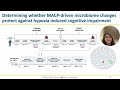
Hypoxia is a physiological condition caused by low oxygen that can impair cognitive function. However, treatments providing cognitive resilience against hypoxic stress are limited. The gut microbiome, the trillions of microbes in the human gut, is an important regulator of brain health, and depletion of the microbiome is linked to cognitive deficits. Recent findings showed that supplementation with microbiota-accessible carbohydrates and polyphenols (MACPs) is associated with improved cognitive performance under hypoxic conditions in humans. This study aimed to investigate whether MACP-driven changes in the gut microbiome protect against hypoxia-induced cognitive deficits. We humanized mice with fecal microbiota from hypoxia-treated human donors, which were supplemented with MACP or placebo snack bars. The mice were then exposed to normoxia or hypoxia conditions and their cognition was tested using the Barnes Maze analysis. The effects of the intervention on learning and memory varied for each donor, preventing hypoxia-induced cognitive deficits in some while enhancing deficits in others. When donor data were pooled, learning and memory outcomes were similar between microbiomes from MACP- and placebo-supplemented donors under both conditions. Overall, these findings suggest that MACP-driven microbiome changes may influence cognition during hypoxic stress in a donor- and condition-dependent manner, supporting personalized microbiome-based interventions.
Presentation 2
LEON LAVONG, Pearl Quijada
This research project will investigate the intersection of dietary intake and cardiovascular pathophysiology, specifically examining the pro-inflammatory impact of ultra-processed foods (UPFs) on the tunica intima. Central to this inquiry is understanding the mechanism that bridges UPFs and impairment of nitric oxide (NO) bioavailability, a vital mediator of endothelial homeostasis. A narrative review will be conducted to analyze multiple peer-reviewed studies on the molecular mechanisms by which UPFs contribute to systemic inflammation and vascular injury. This will include analyzing data on oxidative stress, endothelial degradation, and inflammatory signalling pathways linked to impaired NO production.
Building on this physiological foundation, the research will expand to a socio-economic lens to observe how limited fresh food access in 'food deserts' correlates with higher UPFs consumption. Various literature and demographic/policy analysis of available census and public health data will be examined. By focusing on these systemic barriers, the project will identify why certain marginalized communities are disproportionately vulnerable to the vascular pathologies as previously discussed.
This project will synthesize these molecular and socio-cultural findings into a cohesive, written analysis that bridges cardiovascular biology with community health disparities, thereby providing a translational framework for future research to be conducted.
Presentation 3
Raymond Nova, Jennifer Wilson
Computational methods used for drug repurposing can expedite and improve
the drug discovery process. However, interactome-based models such as PathFX
often suffer from inconsistent prediction performance across multiple diseases. This
study investigated how the curation of underlying gene-phenotype associations affects
PathFX’s drug-phenotype predictions with the aim of improving predictive accuracy
for drug repurposing and revealing novel insights into biological mechanisms that
drive disease pathology. For nine diseases representative of the most common disease
classes in repoDB, genes and gene-disease association (GDA) scores were extracted
from DISGENET. Then, the optimal combination of these genes were found by
sweeping through parameter values of the Prize Collecting Steiner Forest (PCSF)
algorithm, which connects essential genes to each other, as well as novel, hidden
genes that may play under-investigated roles in a disease pathway. A gene list was
chosen to update PathFX gene-phenotype associations through GO Enrichment by
analyzing biological clusters that appear with each hyperparameter. The successful
development and implementation of this pipeline represents a key precursor for
updating gene-phenotype associations for thousands of diseases and assessing their
effects on PathFX predictions across disease classes in order to build an improved
framework for drug repurposing.
Presentation 4
CHAKRIYA OAK. Jing Huang, Shijie Wen
Inflammation is a critical immune response that must be tightly regulated to prevent tissue damage. Dysregulated or chronic inflammation is a hallmark of many age-related diseases, including conditions such as arthritis and gout. Lipopolysaccharide (LPS), a component of the outer membrane of Gram-negative bacteria, is commonly used to stimulate innate immune cells and induce pro-inflammatory cytokines. This project investigates how spermidine, a polyamine known to promote autophagy, and alpha-ketoglutarate (α-KG), a key metabolic intermediate, modulate cytokine production in THP-1 human monocytic cells. THP-1 cells were cultured and stimulated with LPS. Experimental groups included treatment with spermidine or α-KG individually at a final concentration of 10 millimolar, or a combination treatment in which each compound was applied at 5 millimolar. Supernatants were collected after treatment and analyzed using enzyme-linked immunosorbent assays to quantify cytokine secretion. Preliminary results suggest that spermidine and α-KG individually reduce pro-inflammatory cytokine levels, while the combination may have an additive or synergistic effect in attenuating LPS-induced responses. These findings indicate that metabolic modulation through spermidine and α-KG can influence inflammatory signaling in human monocytes. This work highlights the potential relevance of targeting cellular metabolism to regulate inflammation in the context of age-related inflammatory diseases.
Presentation 5
ARI W. PHAN, Stephanie B. Orchanian, Lewis W. Yu, Elaine Y. Hsiao
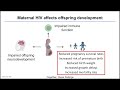
Tryptophan (Trp) is an amino acid and signaling molecule that is required to meet the increased metabolic and developmental demands of pregnancy. Gestational low-protein diets, which reduce Trp availability, have been associated with maternal immune dysregulation and altered offspring neurodevelopment. Similarly, reduced circulating Trp has been reported in HIV-infected women, whose children are at increased risk for inflammatory and neurocognitive disorders. Despite these associations, it remains unclear whether maternal Trp restriction alone is sufficient to disrupt maternal immune homeostasis and impair early offspring growth and immune development. To address this, we fed mice a 50% reduced Trp diet (TRP-D) or a matched isocaloric control diet from two weeks preconception through lactation. At postnatal day (P) 0, there were no statistically significant differences between TRP-D dams and pups compared to controls. However, the TRP-D pups had trending reductions in body and brain weight. At P8, TRP-D pups had reduced body weight and a trend toward increased spleen mass, with increased proportions of MHCII+ macrophages and Ly6C+ monocytes. Additionally, TRP-D dams had increased proportions of MHCII+ macrophages and B cells, and decreased proportions of CD8+ T cells. These results indicate that maternal Trp insufficiency, independent of total protein restriction, impairs early offspring growth and perturbs maternal and neonatal immune composition, suggesting potential benefit from Trp repletion in deficient populations.
Presentation 6
ILIA TALEBI DOLOUEI, Madeleine Milner, Natalia Ermolova, and Ambre Bertholet
One effective treatment for obesity is increasing energy expenditure through mitochondrial thermogenesis. Electron transport chain proteins pump H + into the intermembrane space to establish a H + gradient across the inner mitochondrial membrane used in part to generate heat by the ADP/ATP carrier protein (AAC). While enhancing heat production through AAC could be a promising therapeutic for obesity, the molecular mechanisms for selectively increasing thermogenesis are unclear. We found that H + current through AAC is potentiated under oxidizing conditions, in line with previous findings that mitochondrial thermogenesis increases in the presence of reactive oxygen species (ROS). We propose that oxidative post-translational modification of AAC cysteine residues is responsible for heat production potentiation during an oxidative challenge. We investigated mitochondrial morphology using a fluorescent marker encoded in the mitochondrial matrix, as the observed changes could indicate differences in thermogenic capacity. We screened AAC cysteine-to alanine mutants individually for impaired mitochondrial morphology under basal and oxidative conditions. Mitochondrial fragmentation is a well-established cellular response to ROS accumulation, which we use to identify the key cysteine mutation that results in loss of thermogenesis after an oxidative challenge. This work seeks to delineate the mechanisms of AAC-dependent thermogenesis, thereby supporting the development of therapeutics for obesity by increasing energy expenditure.
Presentation 6
MICAH TAW, Meileen Taw, Joshua Zhong, Zhiwei Fu, Nancy Ly, Victoria Lu, Rupo Lee, Zhaoping Li
Objectives: The aim of this study was to assess the impact of grape, as a source of dietary polyphenols and fibers, on microbial metabolites short-chain fatty acid (SCFA) production and its association with systemic and gut immune status in healthy, free‐living adults.
Methods: 19 healthy adults were assigned to a two-phase intervention study, including a 4-week standardization phase during which participants maintained a low-polyphenol, low-fiber diet, and a 4-week intervention phase with the addition of grape powder daily.
Results: After four weeks of grape powder intake, fecal SCFA concentrations were significantly reduced, whereas plasma SCFA levels remained unchanged. Changes from baseline in fecal SCFA and plasma butyrate levels were significantly associated with the Healthy Eating Index‐2015, but not with microbial diversity. Systemic inflammation (high-sensitivity C-reactive protein), gut inflammation (fecal calprotectin), and gut permeability (lipopolysaccharide-binding protein) did not change over the intervention period. Among other secondary systemic immune markers assessed, a significant reduction in IL‐4 levels was observed.
Conclusions: These findings suggest dietary quality plays an important role in microbial metabolic function, and indicate the potential of grape consumption to enhance dietary quality and help maintain immune balance in clinically healthy individuals. Further research in larger, more diverse populations is needed to confirm these findings and to clarify their broader health implications.
Presentation 7
ANISA WARSHAN, Alvin P. Chan, Elizabeth J. Tarling, Thomas Q. de Aguiar Vallim
Metabolic dysfunction–associated steatohepatitis (MASH) is a progressive liver disease characterized by hepatic lipid accumulation, inflammation, and fibrosis. Intestinal lipase inhibition used as a weight loss therapy indiscriminately reduces dietary fat absorption, yet its effect on MASH progression is yet to be fully understood. Here, we examined the metabolic consequences of intestinal lipase inhibition in MASH. To induce disease, mice were fed a Gubra-Amylin NASH (GAN) diet with and without the lipase inhibitor orlistat. Although orlistat prevented obesity by limiting fat absorption, it failed to prevent liver disease progression. Lipidomic analyses revealed that broad inhibition of fat absorption depleted hepatic polyunsaturated fatty acids (PUFAs) while increasing saturated fatty acids. These changes suggest that orlistat disrupts intestinal fatty acid absorption and remodels hepatic lipid composition in a manner that worsens liver disease. Overall, this work shows that reducing fat absorption protects against obesity but exacerbates liver disease. These findings highlight the importance of dietary composition in MASH progression and its role as a critical determinant for therapies targeting fat absorption.
Presentation 8
HAYEON YANG, Gaven Mann, Fayal Abderemane-Ali
Voltage-gated sodium channels (Navs) play a crucial role in the initiation and propagation of action potentials in major tissues of our body, including the brain, heart, and peripheral nerves. The human genome encodes nine Nav isoforms (Nav1.1-Nav1.9), each with distinct physiological functions and tissue constructs. Disruption of Nav function is associated with various channelopathies, such as epilepsy and cardiac arrhythmias. Currently approved Nav inhibitor drugs target the highly conserved pore domain, leading to non-selective blockade across other isoforms and resulting in unintended side effects. To address this, our project aims to identify isoform-selective Nav inhibitors that act on the voltage-sensing domains (VSDs), which offer greater specificity. We hypothesize that molecules capable of selectively interacting with voltage-sensing domains of Navs can effectively inhibit sodium influx and prevent cytotoxicity. To test this, we developed a high-throughput, cell viability-based screening assay using engineered HEK-293 cells expressing a constitutively open bacterial sodium channel. Assay conditions were optimized and validated through pilot studies and Z′-factor analysis to ensure robustness and accuracy. Initial screening of the small molecule libraries identified several hit compounds. We expect to identify compounds that demonstrate sodium channel inhibition and restore cell viability, providing the groundwork for isoform-specific development of therapeutics for channelopathies with reduced off-target outcomes.