Anthropology and Gender Studies: Prerecorded presentation - Panel 3
Location: Online - Prerecorded
Presentation 1
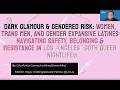
CRIS AVITIA CAMACHO
This project investigates how queer, trans, and gender-expansive Latinx people—especially those who are not cis men—experience safety, belonging, and resistance in Los Ángeles’ goth nightlife. While nightlife scholarship often foregrounds aesthetics and cultural production, this study centers the everyday power dynamics that shape who can enter, stay, and feel safe: racialized gatekeeping, gender regulation, and the persistent risk of harassment, objectification, and gendered violence. Drawing on ethnographic fieldwork across goth venues, the project combines participant observation, semi-structured and informal interviews, and analysis of music, fashion, and performance as embodied practices. Participants will also be invited to share testimonios—first-person narratives grounded in Chicanx feminist and Latin American traditions—to treat lived experience as both knowledge and method.
Here, resistance exceeds individual self-expression. It includes mutual aid events, collective strategies of community care, and organizing efforts that carve out safer spaces in defiance of exclusionary norms within mainstream and subcultural scenes. By tracing these practices, the study shows how non-cis men use nightlife as a site of cultural creativity and solidarity-building, where participants confront risk while asserting presence and transforming the dancefloor into a space of queer, feminist, and decolonial world-making.
Presentation 2
ISABEL COLBURN
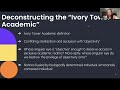
Affect refers to the interplay between emotions, moods, sensorial experiences, and biological physical responses which arise as an individual interacts with their environment. Affect theory is a framework which traces affect itself, analyzing the role of affect on present and subsequent realities. This research aims to analyze the impact of affect theory in addressing the exclusionary nature of academia, which functions upon foundations of racism, patriarchy, homophobia/transphobia, xenophobia, and other forms of bigotry. I engage in a theoretical analysis of the following texts as the basis for my research: The Transmission of Affect by Teresa Brennan; Touching Feeling : Affect, Pedagogy, Performativity by Eve Sedgwick; and The Sense of Brown by José Esteban Muñoz. Through this textual analysis, I imagine realities in which scholars apply elements of affect theory to academic spaces, positioning it as an applicable remedy for the restrictive nature of academia today. Ultimately, this research addresses the violent exclusions committed within academia by targeting the way scholars think about knowledge making. In offering an alternate perspective to the rigidity, isolation, and bureaucracy of academia we currently observe, affect theory permits a future of learning which opposes bigoted norms. When considered within the context of the current U.S. political administration – whose actions repeatedly antagonize U.S. education systems at every level – cultivating inclusive community in academia is of the utmost importance.
Presentation 3
KAITLYN HETSKO
LEO RAMIREZ
Dan Bustillo
Gender Expression is a widely documented pillar of social interaction and defines how one is perceived in the world. In a cisnormative framework, like much of the world is engaged in, “Gender Norms” work to corroborate and shape how we understand and categorize people. When these expectations are transgressed, psychological theory suggests the human mind perceives the ‘offending’ individual negatively. The gap in research seeks to understand how everyday interpersonal perception fares for people who transgress gender norms. Therefore, this study seeks to investigate how gender expression that differs from biological sex influences social perception of individuals who are nonconforming such as trans and nonbinary individuals. This study uses a literature-based review and analysis of existing psychological research on gender expression and social perception. In previous cases studied, those who express their gender according to what society expects from them have a better perception and therefore are treated better than those whose gender expression transgresses from heterosexual norms. These findings may suggest that differentiation from gender norms can lead to unfair unfavorable interpersonal judgments, possibly due to expectation violation and difficulty in social categorization.
Presentation 4
AASTHA KASHYAP
This project explores how embodied performance and dance traditions can serve as vehicles for communicating ethnographic knowledge. In this case, the performance tradition in question is the Bharatanatyam dance tradition, originating in South India, used to create a novel choreographic inquiry titled Sakhi: Sapphic Experiences within Female Friendship. Throughout the process of choreographing, performing, and annotating this autoethnographic piece, I interrogate how performers and artists, through their works, construct, depict, and discuss ethnographic knowledge through the medium of their artistic grammar across multiple modes of communication. To capture and describe the dance elements and techniques that enable these activities, I use transcription methods that translate Bharatanatyam performance concepts, such as charis and mudras, into movement and gestural shorthand that capture the choreography's semiotic content and character. From these transcripts, it is possible to conclude that the content of theater and dance performance in the Bharatanatyam tradition enables multimodal communication beyond character-to-character interactions, with the audience acting as both collaborators and recipients of a performer’s conclusions. In the case of Sakhi, the titular character of the choreographic inquiry, the performer explores sapphic women's struggles to navigate existing social structures and conventions, like heterosexual love and reciprocal female friendship, amid external and internal stigmatization.
Presentation 5
ISAIAH LYTLE HERNANDEZ
With housing insecurity on the rise across the globe, it is becoming increasingly necessary to understand not only how such a trend might be mitigated but also why the existing framework of public services and private contractors fails to successfully curb the issues’ growth on a local scale. It is particularly important to understand this failure from the perspective of those most affected by the issue, i.e., unhoused individuals, if we truly want to rectify the problem of housing insecurity. This paper aims to use interviews, paired with qualitative thematic analysis, to understand the concerns of unhoused individuals currently living in interim housing sites in and around Culver City, CA, a rapidly gentrifying neighborhood situated in the highly expensive West LA housing market. The ultimate goal of this qualitative, participant-driven study is to understand just how interim housing has failed people on an individual level, prioritizing personal experiences to develop an understanding of how the government's approach to stemming the homelessness crisis may be revised.
Presentation 7
SELENA RODRIGUEZ, Kency Cornejo
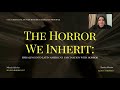
The subgenre of Latin American horror operates as both a traditional and evolving form of expression that exceeds the boundaries of entertainment, functioning as a critical language through which communities interpret collective fear in relation to lived and historical realities. While often reduced to a reflection of colonial violence and its enduring afterlives, such interpretations overlook the genre’s transatlantic formation and its development alongside broader intellectual and gothic aesthetic movements, including modernism and postcolonial critique. This qualitative study examines how horror serves as a living cultural practice across Latin America. By situating Latin American horror within these frameworks, this project explores how inherited structures of fear are reshaped across time and space. Methodologically, the study employs comparative analysis of film and literature across Mexico, Guatemala, the Dominican Republic, Argentina, and Chile, alongside interpretive ethnography to engage contemporary discourse and trace the regional variety of storytelling traditions. Particular attention is given to the circulation of narratives and the intersections of Indigenous cosmologies, colonial epistemologies, and modernist aesthetics. Ultimately, the findings suggest that Latin American horror functions as a cultural practice that articulates resilience and enables sustained engagement with the legacies of coloniality.