Sociology and Public Affairs: Prerecorded presentation - Panel 1
Location: Online - Prerecorded
Presentation 2
BRENDA CEDILLOS, Naomi Sugie
Spanish- and English-speaking Incarcerated Individuals: Similarities and Differences in Their Experiences During the COVID-19 Pandemic
Existing scholarship explores the prison living conditions, inequalities, and access to medical or legal access of incarcerated individuals in the United States; however, it overlooks the role language plays in shaping their experiences during a health-crisis period. This study addresses this gap through analysis of call and letters contributed by people incarcerated in California prison and jails, and collected by the PrisonPandemic project, during the COVID-19 pandemic. It focuses on language as a factor that influenced how incarcerated individuals navigated the COVID-19 pandemic, including gaining access to information, interpretations of institutional responses, and coping strategies. The findings reveal how both Spanish- and English speaking incarcerated people expressed concerns about COVID-19 mitigation policies, and feelings of worry for their families. However, they had different isolation experiences and coping strategies. Spanish speakers felt deeper isolation from communication barriers with their peers, guards, and medical staff. Thus, their coping strategies relied heavily on religion and faith, while English speakers described struggles with mental health, in terms of their own experiences and their incarcerated peers. Although both groups faced systematic struggles, language significantly shaped their experiences and perspectives during the COVID-19 pandemic. The findings call for the need for access to linguistic resources and mental health programs during critical health periods in correctional institutions
Presentation 3
GIANELLA URTECHO
Where Do I Belong?: The Impact of Immigration Status, Political Climate, and National Origin on Immigrant Students’ Sense of Identity and Belonging in Los Angeles
My study examines how immigration status, political climate, and national origin shape immigrant students’ sense of belonging and identity in Los Angeles higher education institutions. As anti-immigrant rhetoric intensifies and ICE enforcement presence increases across California, understanding the factors that influence immigrant students’ safety, identity, and academic experience has become critically urgent.
Using interviews with immigrant students at community colleges in Los Angeles, my thesis explores how variables such as time spent in the country, documentation status, and institutional environment shape students’ perceptions of belonging. Preliminary findings reveal that immigrant students, regardless of legal status, feel increasingly threatened by the current political climate and are more likely to conceal their immigrant identity. Exclusionary experiences, such as being denied access to scholarships and feeling unsafe openly sharing their national origin, further compound these challenges.
This research argues that hostile political climates directly undermine immigrant students’ sense of belonging and academic engagement. The findings point to the urgent need for inclusive institutional programs and policies that actively counteract the effects of exclusionary rhetoric and enforcement-driven fear. By identifying both the barriers and the factors that foster belonging, this study contributes to a growing body of scholarship advocating for equitable and supportive higher education environments.
Presentation 4
EVALYSE ESTRADAFLORES, HANNAH BUTALID, KAELEN SPIEGEL, NINA ZHANG, Natalie Teng, Daniel Eisenberg
Prolonged exposure to acute heat in dormitory settings can have harmful effects on the academic performance and well-being of students, such as reduced attention and adverse mental health outcomes (Bidel et al., 2020). While this research suggests that exposure to heat harms psychosocial well-being and cognitive performance, the majority of research has been conducted in laboratory settings focused on K-12 students. Further research is therefore needed to better understand how heat specifically impacts university students living in college dormitories. This study seeks to fill this gap by administering a voluntary longitudinal survey from October to December 2025 to examine the relationship between indoor heat exposure and student-reported academic and health outcomes among UCLA dormitory residents. Respondents were recruited from campus clubs, flyering efforts, and social media. They were asked to fill out the survey on a weekly basis. Survey data was then cleaned, combined with NOAA UCLA temperature data, and analyzed the data using R. Using ggplot, our team graphed differences in outcomes between residents with AC and those without status. We also plan to conduct quantitative data analysis in the future using multi-level models to assess statistical significance of the observed outcomes. Our present results suggest that further research on the potential harms of dormitory heat exposure is crucial to better understand the heat-related challenges facing college students and inform University housing policies.
Presentation 5
CHLOE HAN
This capstone project addresses the issue of limited resource awareness and decreased social opportunities among the older adult population. Specifically in Culver City, some older adults may be unaware of the programs, services, and connections that are available to them through the Culver City Department of Parks, Recreation, and Community Services via the Culver City Senior Center. This results in the potential underutilization of support systems that could enhance their physical and emotional well-being. These supports include recreational activities, community events, and access to city resources like transportation assistance and medical care referrals. The purpose of this project is to bridge that gap by organizing an open house and resource fair designed to introduce older adults to the Senior Center’s internal resources and programming in a welcome and accessible environment. To complete this project, I will coordinate with staff, administrators, and instructors from the Culver City Senior Citizens Association to host a multi-hour event with sample recreational classes, a tabling fair, facility tours, provided food and entertainment, and other opportunities for engagement. Ultimately, I expect this project to benefit Culver City’s older adult population by fostering a stronger, more informed, and more connected community network which supports their overall well-being, physically and emotionally.
Presentation 6
SUIN KIM
My thesis From Gifts to Commodities: How Digital Payments (Venmo / Zelle) Reshape Social Obligations and Economic Exchanges Among Young Adults," explores how peer-to-peer platforms like Venmo and Zelle are changing the way young adults navigate financial exchanges in social contexts. I investigate how digital payments may blur the line between gifts and commodities, and how these tools shape perceptions of reciprocity, gratitude, and obligation in everyday interactions. I find this to be a timely and important research question that reflects a broader shift in how technology influences our social and economic lives. I use a combination of in-depth interviews, network analysis, and comparative analysis to explore these themes among young adults, starting with UCLA students and later including peers in Bologna.
Presentation 7
RYANN MEJIA-GONZALES
Covering (Up) a Genocide: How Depictions in the Media Impact the Missing and Murdered Indigenous Women and Relatives Crisis
This research project is examining the impact that current media depictions have on the growing rate of missing and murdered indigenous people, specifically women. This problem that has been declared a genocide in Canada, yet still ignored here even with similar incident rates. Quantitative data shows the rates of violence against native women, but also the rates of media coverage for these victims. Qualitative research encompasses both narrative analysis of interviews held with the afflicted families, and thematic analysis of the coverage that is present about these cases. My research has shown that a lack of coverage as a whole highly contributes to the silencing of this problem, and that the media coverage that is available disproportionately portrays native victims in a negative light, reducing the sense of urgency surrounding the issue at hand. With my findings, it is also important to unpack the historical context and imposed stereotypes of indigenous people to fully understand why the media representation is so bad, and how to rectify it moving forward to work towards ending this silent genocide.
Presentation 8
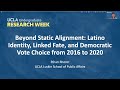
ETHAN RHORER
This project examines variation in Latino presidential vote choice across recent elections and the role of context-dependent identity activation. Drawing on theories of social identity, group consciousness, and linked fate, it evaluates how Latino identity is associated with Democratic presidential vote choice net of socioeconomic characteristics, and how that relationship varies across elections.
Using pooled data from the 2016 and 2020 Collaborative Multiracial Post-Election Survey, the analysis employs survey-weighted logistic regression models to generate predicted probabilities and standardized comparisons across racial groups and election years. It then examines variation within the Latino electorate by levels of linked fate and decomposes changes in Democratic support into components attributable to shifts in linked fate prevalence versus changes in Democratic support within high and low linked fate groups.
The results show that Democratic support declined among both high and low linked fate Latino voters between 2016 and 2020, with only a small share of the decline explained by changes in linked fate prevalence. Instead, most of the change in Latino Democratic support between elections occurs within high and low linked fate groups. These findings suggest that explanations focused solely on changes in group consciousness are incomplete and that broader contextual factors shape Latino vote choice across elections.
Presentation 9
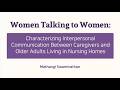
MATHANGI SWAMINATHAN, Lene Levy-Storms
Given the disproportionate number of women in the caregiving and nursing home population, this paper looks at women and communication in nursing home care to address the question: What characterizes interpersonal communication among paid and family caregivers for older adults living in nursing homes? Through this, the older adults’ needs and the manner in which caregivers communicate with them can be deconstructed to craft themes that would be useful in building future educational resources for a variety of caregivers.
This is a qualitative study utilizing data from 6 video clips of interactions between paid or unpaid family caregivers and the older adult at nursing homes to characterize interpersonal communication among them. Using a feminist lens opens up the ability to critically consider women’s needs from both the older adults’ and the caregivers’ perspectives relative to the larger context.
Qualitatively, two themes emerged: “The Irony of Gender” and “Double Jeopardy: Women Facing Ageism.” They characterized unpaid family caregivers' interactions as relatively more emotionally supportive and paid caregivers' interactions as relatively more instrumentally supportive.
Future research along these themes could help improve the quality of care that older adults, especially women, experience in nursing homes. In addition, the insights of the relational dynamics provide a basis for future interventions and educational content. Overall, the findings suggest ways to improve the standard of care and reduce the impact of ageism.