Sociology and Public Affairs: Prerecorded presentation - Panel 4
Location: Online - Prerecorded
Presentation 1
OLIVIA GILCHRIST, ISABELLA REINA, MIYA YAMAMOTO, Laura Liévano-Karim, Ivy Zucaya, Brenda Tully, Tyrone Howard, Taylor Dudley
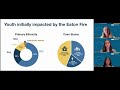
In January 2025, the communities of Altadena, Pasadena, and Sierra Madre experienced substantial destruction and displacement due to the Eaton Fire. Our research examines the impact of the Eaton Fire on the educational disruptions of child welfare system-involved children and youth. An analysis of Department of Children and Family Services (DCFS) case records revealed that three months after the fire, 1 in 6 of the 225 affected youth had relocated with an average distance of 16 miles. Seventeen professionals with insights into the educational rights and day-to-day impact of the fire on children and youth in foster care were interviewed. Findings suggest that the Eaton Fire exacerbated existing educational challenges, impeded receipt of critical school-based supports, and disrupted students’ connections with peers and trusted professionals. Results also highlight important areas where additional planning and infrastructure could benefit child welfare system-involved youth during future natural disasters. These include collaborative efforts to locate students after a disaster, swift school re-enrollment, and timing the provision of school continuity interventions to match student and caregiver needs. Education and child welfare institutions in other jurisdictions can use findings from this study to prepare for catastrophic events and optimize support available to students and staff in the aftermath.
Presentation 2
NAIMA KAHL, Whitney Pirtle
African continental migration to the United States has steadily increased, raising questions regarding the extent of African immigrants’ integration into US racial classification schemes. Despite internal differences in history, culture, and social consciousness, Black classification is often externally monolithic, contributing to intragroup tensions and discourse over disaggregation of subgroups. This study explores different ways African Immigrants and African Americans develop and discuss inclusion to the American Black racial category. First, a comprehensive review of interdisciplinary literature showcased some of the demographic’s complex understandings of identity and social inclusion. Then primary data was analyzed from 1,500 comments submitted by American individuals on proposed changes to the Race/Ethnicity sections in the United States 2030 Census. Using NVivo qualitative data software, the comments were coded with thematic analysis for racial understandings, census appeals, and definitions of the Black label. Results generally reflect increasing movements to restrict the definition of the Black racial category, creating specific classifications for American descendents of slavery which fundamentally alters African immigrant’s categorical positionality. Institutionalized discrimination affects the Black race holistically, and understanding varying intragroup perspectives is crucial to attaining ideological unity and actionably dismantling the hierarchical systems that permeate into the lives of Black individuals.
Presentation 3
KELLY KONG
How do Chinese immigrant women define “hometown,” and how does that understanding shape major life decisions? This qualitative study examines how first-generation Chinese immigrant women in Los Angeles negotiate meanings of “hometown” and mobilize those understandings in planning education, careers, family life, caregiving, and long-term residence. Drawing on 22 in-person semi-structured interviews, this project explores how participants rank and interpret multiple possible “hometowns,” including birthplace, ancestral hometown, current neighborhood, Los Angeles, and the nation-state. Preliminary findings suggest that participants anchor their hometown in layered and transnational ways, often linking specific places in China to kinship obligations, cultural tradition, and imagined future return while simultaneously constructing belonging in Los Angeles through work, family, and community life. These findings demonstrate that “hometown” functions not merely as a symbolic identity marker but as an organizing framework through which immigrant women negotiate belonging and make life-course decisions in the context of migration.
Presentation 4
KATHERINE MARA, and Faith Deckard and Julissa Muñiz
In the second Trump administration, the increased presence of violent ICE raids and the agitation of people against these raids has made immigrants’ rights one of the U.S.’s most divisive topics, leading to protests being met with militant force. Thus, to better understand the narrative around immigrants, protests, and carcerality, this qualitative Critical Discourse Analysis study (CDA) asks: (1) How did select government actors frame the deployment of the National Guard in Los Angeles during the summer of 2025? (2) What logics are made evident in how the issue was narratively framed for a general audience? Using CDA as a methodology and institutional logics as a theoretical framework, this study analyzes media content posted by governmental actors at the federal, state, and city levels during the early deployment of the National Guard to Los Angeles (n=39). The data revealed that all levels of government upheld the carceral state, albeit by different methods of discourse. Where the federal government justified federal intervention, state and city governments stressed local law enforcement’s competency. Additionally, legitimation played a vital role in classifying citizens and immigrants as “criminals” or “bad actors,” and challenging or defending state sovereignty. By realizing the functions of intersecting neoliberal and carceral logics, this study challenges the readers to question who is part of the “us” and who is part of the “them.” Moreover, what is discourse’s role in creating and/or reinforcing these categories?
Presentation 5
JAVIER MURILLO JR
This study examines the impact of cultural and political education on youth from various racial and gang backgrounds concluding their juvenile sentences in academic transitional housing in Southern California. Ethnographic research on public education has shown that marginalized youth endure criminalization facilitated by institutional practices rooted in histories of racial control, surveillance, and cultural subversion, such as zero-tolerance policies and police supervision. Although most studies frame higher levels of education as pacifying and violence-reducing, recent studies complicate this understanding by suggesting that higher levels of education in poor labor markets may contribute to radicalization and political mobilization. Moreover, studies on critical consciousness have shown that marginalized youth in public schooling often express a desire to engage with more critical materials, but typically lack the necessary access and resources. Using a qualitative research design based on interviews with juvenile-justice impacted youth in transitional step-down housing, this study asked: How does cultural and political education impact formerly incarcerated, gang-involved youths’ understanding of street culture and social control institutions? By foregrounding the ontologies of criminalized youth, this study contributes to scholarship on critical education, youth criminalization, and alternative pedagogical models with implications for community-based violence prevention, youth justice reform, and abolitionist education
Presentation 6
AUTHOR: SYEDA REHMAN
Faculty mentor/advisor: Zsuzsa Berend
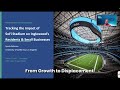
My study analyzes that SoFi Stadium did not create displacement in Inglewood, California. It accelerated a process already underway. Inglewood became vulnerable over decades: white flight, deindustrialization, and the 2008 foreclosure crisis left a city that was 64 percent renters. With no rent control and no meaningful affordable housing requirements. My research question: How SoFi Stadium's development affected Inglewood's demographics and small businesses, and whether rising rents and land values contributed to displacement or adaptation? Utilizing 15 years of ACS data, LA County Assessor records, LoopNet commercial listings, and official city documents dating back to 2009, along with my field research. To avoid bias, I employ triangulation and a process-oriented mechanism. I apply rent gap theory, growth machine theory, and predatory inclusion to explain how it happened. Results include that Median home values grew 136 percent between 2010 and 2024. Rents grew 84 percent. Income grew only 70 percent. Commercial asking rents near SoFi run $24 to $48 per square foot, pricing out local businesses. On Market Street, I saw shuttered storefronts and buildings held vacant by owners waiting for higher-value offers–City experiencing middle phase. This study matters because displacement in Inglewood did not require formal eviction orders.It required a decade of decisions by local officials and private investors that left residents without protection, and its not too late to implement policies in not just on paper but in practice.
Presentation 7
ISABELLA REINA, OLIVIA GILCHRIST, Brenda A. Tully
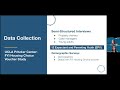
Young people in foster care are at high risk of homelessness as they transition out of the system between ages 18 and 21. Furthermore, experience with the foster care system is correlated with a higher incidence of becoming pregnant or a parent prior to aging out of the system. One intervention designed to reduce homelessness among youth aging out of foster care is the Foster Youth to Independence (FYI) Housing Choice Voucher program, which is available to all transition-age youth between ages 18 and 24, including expectant and parenting youth. The FYI program provides vouchers to transition-age foster youth to subsidize rent for private market apartments. The housing preferences and experiences of expectant and parenting youth transitioning out of foster care are historically understudied. Our aim is to understand the barriers and facilitators of the FYI program from the perspective of expectant and parenting youth. We interviewed 12 expectant and parenting youth, with an average age of 23 years old, to learn about their experiences with the FYI program process. Preliminary findings highlight expectant and parenting youths’ interest in searching for and securing stable housing particularly suitable for young children, considering factors such as neighborhood safety and accessibility. By expanding our understanding of the experiences of expectant or parenting youth with the FYI voucher process, we will create policy recommendations to advocate for their unique housing needs.
Presentation 8
MANROOP KAUR TURNA
This project examines how insurance type and employer affiliation shape access to vision care and influence the quality of treatment patients receive. In the United States, vision care is often treated as a supplementary benefit, creating variation in coverage that may reflect broader social and economic inequalities. This study asks how differences in insurance plans, particularly those tied to employers, affect patient access to exams, corrective lenses, and follow up care.
The project focuses on comparing insurance coverage structures, employer affiliations, and benefit patterns, such as copays and benefits. Employers are used as a proxy for the occupational sector to evaluate how workplace-linked insurance influences care accessibility. Preliminary observations suggest that patients with insurance provided by large private-sector employers often experience lower out-of-pocket costs and greater coverage for vision services compared to those with public or university affiliated plans.
This project also considers the broader structure of the vision care industry, including the market influence of major corporations, to understand how access is shaped at both the patient and systemic levels. By identifying how insurance and employment intersect to produce unequal care, this research highlights the role of structural factors in shaping health outcomes and access to essential services.