Welcome to UCLA Undergraduate Research Week 2026!

Thank you for visiting the 2026 Undergraduate Research and Creativity Showcase. This Showcase features student research and creative projects across all disciplines. As a university campus, free expression is encouraged, and some content may not be appropriate for all ages. Visitors under the age of 18 are encouraged to explore these presentations with a parent or guardian. The views and opinions expressed here are those of the participants and do not necessarily reflect UCLA or any policy or position of UCLA. As a visitor, you agree not to record, copy, or reproduce any of the material featured here. By clicking on the "Agree" button below, you understand and agree to these terms.

Arts, Music, and Multimedia: Prerecorded presentation - Panel 1

Location: Online - Prerecorded

video
Presentation 1
TRISTIAN KINNEY
Broken Baby Doll is a narrative film developed from my lived experience observing my grandmother’s progression with dementia and the emotional impact it had on my family over time. This project asks: how does memory loss reshape identity, and how do caregiving roles evolve as a loved one’s sense of self begins to deteriorate? This work functions as qualitative, practice-based research grounded in long-term personal observation and reflection. I draw from specific behavioral patterns I witnessed, including confusion, repetition, and moments of disorientation, and translate them into narrative form through the character of Jonathan. Using naturalistic Uta-Hagen based performance, handheld cinematography, and real-time scene construction, I prioritize immediacy and emotional authenticity as primary research methods, allowing lived experience to inform both structure and character behavior, drawing inspiration from the naturalistic filmmaking approach of Chloé Zhao in Nomadland. Through this process, the project finds that memory loss operates not as a singular event but as a gradual accumulation of absences that disrupt identity and invert relational dynamics. Jonathan’s attempts to maintain control and protect what remains reveal the emotional limits of caregiving when faced with irreversible change. The significance of Broken Baby Doll lies in its contribution to practice-based research by transforming personal experience into a cinematic exploration of dementia, offering an intimate and human-centered perspective on memory,
video
Presentation 2
BENJAMIN KRUT
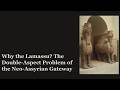
The monumental lamassu, a human-headed winged bull, is among the most iconic forms in Neo-Assyrian art. While scholarship has addressed the figure's symbolism and apotropaic function, less attention has been paid to a more fundamental question. Why, out of the Neo-Assyrian repertoire of composite protective beings, was the lamassu chosen for monumental installation at the palace gateway? This project argues the lamassu was selected not for what its parts represent, but because its composite body is the only form that works from both vantage points the gateway demands. The threshold poses a unique compositional problem. Any figure occupying it must be legible from the frontal approach and the lateral passage, each demanding a different visual composition. Through close formal analysis of surviving sculptures, this project shows that the lamassu's body is a precise solution to this double-aspect problem. The human face, carved in bilateral symmetry and rare frontality, produces a descending gaze along the axis of approach, establishing the visual confrontation that contemporaneous inscriptions ascribe to gateway figures. The animal body in profile, with its horizontal momentum and modeled musculature, addresses the lateral view as the visitor passes through. The fifth leg serves as the hinge between these two views. This reframing demonstrates that formal analysis can recover the practical, architectural reasoning behind Neo-Assyrian artistic choices often treated as purely symbolic.
Presentation 3
PAVAN RADHAKRISHNAN
Nicolae Sulac and Orchestra Lăutarii: A National Turn in Soviet Moldovan Folk Music
Orchestra națională de muzica populară „Lăutarii” (the national muzica populară orchestra Lăutarii) has become a symbol of national identity in the Republic of Moldova, a tiny, landlocked post-Soviet republic in Eastern Europe. Founded under superstar singer Nicolae Sulac in 1970, Lăutarii is an orchestral variant of muzica populară, an officially mediated genre of folk music developed in Romanian-speaking territories after the Second World War. Archival documents from the Moldovan State Philharmonic reveal examples of the orchestra’s interactions with Soviet authorities in the 1970s, which included an emphasis on peripheral interethnic musical exchange, Russian language communication, ethnic and geographic identity distortion, Communist Party political messaging, Union-wide tours, and economic and organizational uncertainty. Acknowledging the “authoritarian” influence of the soloist on the orchestra’s artistic activity characteristic of the genre, this paper argues that Nicolae Sulac’s innovations successfully distinguished Orchestra Lăutarii from its counterparts as a symbol of nationalist, anticolonial resistance ahead of its time. His innovations include the ethnographic collection and subsequent repertorial curation of an increased degree of territorially “authentic” ethnic Moldovan music, as well as a deliberately misleading naming choice for the orchestra and well-timed public tributes to the regime’s leaders. Unfortunately, Sulac’s contributions are insufficiently explored in newer regional scholarship.
video
Presentation 4
JOCELYN SERRANO

The Garifuna are an Afro-Indigenous community, residing along the east coast of Central America, that retain their traditional practices rooted in Indigenous, African, and European influence. Amidst a growing diaspora, the ephemerality of these traditional practices is ever more prevalent, sparking community movement to preserve them. This research contributes to this ongoing movement by documenting their traditional methods of making and relating them to identity and historical exchanges with other Indigenous communities. Incorporating a perspective that highlights hybridity and creolization is essential as the retention of heritage fundamentally tied to colonial hostility is an important aspect of the Garifuna history and expression. In this research I will document their practices by reviewing academic literature, museum catalogs, and ethnographic sources about Garifuna traditions and intercultural connections. Secondly, I will document and analyze a selected group of Garifuna-related objects held in museum or community collections. Visual analysis and scientific investigations (e.g., X-ray fluorescence spectroscopy, infrared absorption spectroscopy, and Raman spectroscopy) will then be utilized to investigate materials like wood, fibers, animal skin, resins, and pigments. This step is taken because understanding materiality aids in identifying making techniques and cultural priorities. Through interdisciplinary approaches, this research safeguards Garifuna traditions.


video
Presentation 5
ZIYAN XIE
See/Saw is a playable documentary that exposes the operational layer of machine vision algorithms. It is inspired by Harun Farocki's concept of the "operational image", which do not represent an object but are part of an operation. In the era of automated surveillance, seeing is a mechanical process of imposing order. By positioning the participant as an operator within a surveillance apparatus, the work reveals the hidden labor of automated perception: the detection, classification, and suppression of divergence. The work is grounded in the mathematical principles of flow field regularization and rendered in Unity. In computer vision, algorithms often holds the assumption that neighboring elements should move with similar vectors. This project transforms these technical constraints into metaphoric tools for social and physical control, rendered interactive through the conventions of a video game. Through scan point arrays and density annotations, the participant engages in a cold, numeric rhythm of seeing, classifying, and acting. At the end of gameplay, a documentary assembled from thematically resonant public domain footage is shown alongside a replay of the session—a juxtaposition that holds the abstraction of algorithmic logic against the weight of the real. Asking what is lost when machines smooth human movement, and who decides which patterns constitute a threat, the work offers no answer. In the absolute silence of the processed field, we are left to confront the mechanical violence of smoothness.