Community Engagement, Disability and Social Justice: Prerecorded presentation - Panel 1
Location: Online - Prerecorded
Presentation 1
KRTTIKA KUMAR
Editors: Evrim Tuncel, Isabella Marasco
This article argues that U.S. courts have systematically misconstrued consent in sterilization cases by treating it as a matter of procedural compliance rather than a substantive safeguard of reproductive autonomy. In the latter half of the twentieth century, thousands of women underwent sterilization under conditions that compromised meaningful choice. Yet, courts evaluating these claims have focused narrowly on whether formal consent requirements were satisfied, often deferring to signed documentation while overlooking the institutional and structural pressures that shaped decision-making. Through analysis of Relf v. Weinberger (1974) and Madrigal v. Quilligan (1978), this article demonstrates how judicial reliance on formal authorization obscures coercion and shields medical and state actors from accountability. Situating these decisions within the broader legacy of eugenics and federal family planning programs, it identifies a doctrinal gap in how voluntariness is assessed. It then advances a reconceptualization of consent founded on constitutional principles of due process and bodily integrity, proposing a contextual framework that accounts for factors such as timing, comprehension, institutional dependency, and provider authority. By reframing consent as a substantive inquiry, this article argues that the United States legal system can better identify and address structural coercion in reproductive decision-making.
Presentation 2
CLARIS E. PREDMORE
In previous research done on the impact of AAC and how it is implemented, it is clear that AAC provides a significant benefit to children who have complex communication needs. It is also clear that current interventions lack vital training for professionals, families, and individuals who use AAC. This work consists of a literature review and informational interviews. The goal of the literature review is to summarize the foundation of AAC, and to provide a timeline of the development of AAC to where it is now. Interviews were conducted to attempt to gain a better understanding of the experience of service providers, particularly in education, who work with children who use AAC, specifically with regard to their training on AAC and how confident they feel implementing evaluations and interventions. This work offers a historical review of the foundations of AAC, leading into the current practices around AAC intervention and training for professionals. From literature review and informational interviews, it is clear to see that educators do not feel prepared to provide AAC assessments or interventions. It is also evident AAC was made in order to meet users’ immediate needs. Now that AAC is so complex, it has the ability to provide psychosocial support for people who don’t use verbal language. It is important to continue to develop interventions for AAC so that more people can receive all that it has to offer.
Presentation 3
ALTHEA NICOLE DE VERA BRAVO
The experiences of individuals with multiple chemical sensitivities (MCS) are entangled with oppressive power structures that produce an overlooked intersection between environmental illnesses and housing insecurity. Rowena Ilagan’s interviews, from the UCLA Chemical Entanglements oral histories archive, reveal the complex ways in which violence sustains itself within a capitalist regime. This system disempowers and displaces vulnerable populations, leading to housing insecurity, social isolation, and exacerbating symptoms. Rowena Iligan’s experience with MCS, triggered by mold, reveals how household mold functions not just as an environmental hazard but as a form of structural and spatial violence produced through toxic politics, organized abandonment, and inadequate housing and mold policies. These conditions destabilize the homespace, undermine the legitimacy of environmental illnesses, and increase housing insecurity among marginalized and chemically sensitive populations. By situating household mold within a toxic politics framework, we can unpack the structural power relations that uphold the slow violence of mold and environmental illnesses through relative invisibility, uncanniness, and temporal and spatial dispersion. After unpacking the structural implications of household mold, this paper examines how household mold is held accountable in policy and litigation, how individuals with MCS are affected by housing insecurity, and the efforts of MCS communities to secure safe and affordable housing.
Presentation 4
JULIETTE RODRIGUEZ
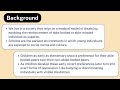
When examining early adolescents, their primary source of socialization occurs in school environments, such as the classroom or playground. These areas have high social opportunities for peer-to-peer & peer to teacher relationships via interplay or fostering relationships. However, social environments are susceptible to social norms and biases that affect the interplay and relationships between individuals. Existing literature highlights how children demonstrated a strong preference for abled-bodied peers over non-abled-bodied peers as early as elementary school. Along with higher risk for stigma and bullying to occur for disabled students. While a lot of research has been done to examine the interplay/relation of disabled and non-disabled students in school social contexts, there is a lack of research examining the interplay and interconnection between disabled students. I will collect data via direct on campus observations of student to student interaction on the playground apparatus and sport field. I will collect interviews about the relationships of students from teachers and staff. Based on preliminary observations, students with disabilities can sometimes reinforce preferences for able-bodied norms in social interplay and interactions by utilizing exclusionary behaviors and stigmatizing language/labels for their peers with different disabilities. Adding to the existing literature on how able-bodied social norms interact with adolescent youth in educational spaces.