Business, Entrepreneurship, and Social Impact: Prerecorded presentation - Panel 1
Location: Online - Prerecorded
Presentation 1
EUNWOO KIM, Delaney Buskard, Magali A. Delmas
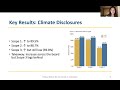
As climate change and related socioeconomic pressures intensify, corporations are increasingly expected to play a role in global sustainability. One emerging tool in this effort is the climate transition plan — a framework used by companies to guide their progress toward net-zero greenhouse gas (GHG) emissions through clear goals, timeframes, and accountability mechanisms. The credibility of these plans depends heavily on transparency and regulatory standards. This research evaluates how S&P 500 companies disclose climate transition plans, using the Carbon Disclosure Project’s (CDP) framework and a set of 38 key metrics.
In collaboration with the UCLA Anderson School of Management’s Open for Good (OFG) initiative, these metrics were scored across three pillars — ambition, action, and accountability — using a 0 to 1 scale based on clarity and completeness of disclosure. Results show that while over half of companies claim a net-zero target, only 24.4% report a transition plan, and financial planning remains the most underdisclosed area. Sector-level differences further underscore the role of regulation in shaping disclosure practices. These findings reveal a significant disconnect between climate ambition and implementation, pointing to the need for stronger alignment between corporate commitments, investment strategies, and governance structures.
Presentation 2
DIYA MADHAVAN, VIBHA DODDIPALLE, EMILY MILLS, MINDY HUYNH, LILLIAN NOVOTNY, JASMIN JABARA, Sophia Gnuse, Brandon Lim, Diego Aviles, Emma O' Connell, Aurelia Bernier, Ecesu Erdim
GLP-1 receptor agonists have emerged as the dominant therapeutic class for the management of obesity and type 2 diabetes, with Novo Nordisk and Eli Lilly leading the market with semaglutide and tirzepatide, respectively. Despite Novo Nordisk's earlier market entry, Eli Lilly has achieved sustained competitive gains, a reversal that clinical differentiation alone does not fully explain. This study investigates how supply constraints, FDA shortage designations, and compounding pharmacy dynamics reshaped competitive outcomes in the GLP-1 market between 2021 and 2025. Unlike traditional pharmaceutical markets, where physician adoption and clinical efficacy drive market share, GLP-1 uptake has been shaped by consumer awareness, tele-health prescribing, and direct-to-patient access, making supply reliability itself a competitive variable. Using a comparative case study framework, we synthesized FDA shortage records, earnings disclosures, and prescribing trends for both firms. Analysis indicates that Novo Nordisk's prolonged shortage periods created a window for compounding pharmacies to establish a lower-cost alternative market during peak demand growth, while Lilly's earlier capacity stabilization allowed it to capture that same demand through its branded product. These findings suggest that manufacturing readiness carries an under appreciated competitive weight in consumer-driven pharmaceutical markets and can shape competition in ways traditional pharmaceutical market models may not anticipate.
Presentation 3
SIDNEY MUNTEAN
This project examines how AI tools affect professional identity and perceptions of trust and authenticity in hiring environments. As platforms like LinkedIn increasingly automate profile creation, professional identity is maximized for both human and AI system review, raising questions about how credibility is evaluated.
The study asks: how does perceived AI authorship affect trust and perceived authenticity in professional self-presentation?
To investigate this, I combine three methods. I first examine how LinkedIn’s interface, recommendation systems, and profile prompts guide users toward standardized, machine-legible representations of identity. Then, I created an experiment that uses AI to generate LinkedIn-style biographies for UCLA students under different conditions to compare tone and narrative. Ultimately, a perception survey asks participants to evaluate biographies on credibility, trust, authenticity, and voice using a within-subject design.
Results show that the effects of AI authorship are context-dependent. AI-generated profiles are often perceived as more polished but less personal, and differences in trust are influenced by exposure order rather than content alone.
This project demonstrates that AI does not inherently reduce trust, but fundamentally changes how trust is formed. These findings have implications for hiring practices, suggesting that organizations must reconsider how authenticity is evaluated in recruiting processes.
Presentation 4
LUCY RICH
This study examines the effects of the blind box model on consumer preferences and behaviors among young Americans. A blind box is a randomized, probabilistic type of good, where the consumer does not know which product style they will receive from a set of offerings until after completing the purchase. Key theoretical frameworks include the psychological effects of uncertainty and emotional design, addictive gambling mechanisms, commodified authenticity, identity formation, community belonging, and cultural capital. Guiding research questions included: "What features attract consumers to this model?", and "How does the rise of blind boxes reflect consumer preferences & behaviors among young Americans?" This study draws on previous literature in the field to predict that framing blind boxes as surprising, rare, or popular will increase consumer preference for the model, whereas questioning authenticity will lower it. Using an experimental methodology, this research surveys young adults aged 18-28 to analyze their perceptions of the blind box economy and the motivational drivers behind its popularity, in the context of the current economic and psychosocial environment in the United States. Previous studies have relied on theory and qualitative methods to analyze consumer behavior, with relatively limited empirical studies. Moreover, most blind box economy research thus far has examined Asian consumer preferences. This study aims to shed light on cultural differences with quantitative data by focusing on American consumers.
Presentation 5
KYRA SHAH, ELIZABETH SAUTTER, ELLISON KORMAN, NITYA JHAMB, ROHAN GIANCHANDANI, SAHASRA KALLURI, Vinay Panchal, Jason Yu, Jiaa Bartake, Josephine Wong, Trevor Kuo, Laasya Balupari
Operating room (OR) inefficiency contributes substantially to institutional costs, clinician burnout, patient access delays, and workflow instability. Surgical case duration estimation remains a foundational component of OR scheduling, however, many hospitals continue to rely on surgeon estimates or historical averages despite documented inaccuracy and systematic bias. In recent years, artificial intelligence (AI) based models have been developed to improve surgical duration prediction, yet hospital executives lack a system-level synthesis translating model performance into operational guidance.
This review evaluates current evidence on machine learning and deep learning approaches for predicting surgical case duration and related perioperative workflow outcomes. Across studies, neural network-based approaches consistently outperformed traditional estimation methods. Models incorporating intraoperative variables demonstrated the greatest reduction in large prediction errors. Live or near real-time models showed the most meaningful operational benefits, including reductions in patient wait times, overtime, and scheduling disruptions.
Although differences in reporting standards make direct comparisons across models challenging, cumulative evidence suggests that AI-based surgical duration prediction represents a practical, low-risk, high return on investment application of AI in healthcare operations.