Biology: Prerecorded presentation - Panel 4
Location: Online - Prerecorded
Presentation 1
JOSEPH BORNA, and Eric Ellison
Background: Climate change, and its associated effects on freshwater temperatures, can impact fish physiology, altering pigmentation and mating behavior. In guppies (Poecilia reticulata), carotenoid-based coloration largely influences female mate choice, making them a useful model for examining how thermal stress impacts sexual selection. Materials and Methods: We conducted an experimental study focused on temperature manipulation, aiming to analyze the effect of rising water temperatures on natural selection and guppy health. Two identical aquaria were used: one control tank was maintained at baseline environmental conditions, while an experimental tank was subjected to a +3 °C increase via a submersible water heater. Each tank was maintained for 6 months, allowing observation across three generations. Diet, lighting, and water chemistry were standardized between tanks to ensure proper validity. Results: We found that continued exposure to elevated water conditions correlated with increased expression and intensity of carotenoid-based coloration, which was associated with higher mating success from females. Interestingly, our findings diverge from previous literature, which often suggests that thermal stress inhibits vibrant coloration among fish populations, highlighting the need for further research to better understand the relationship between climate change and adaptive phenotypic changes within aquatic environments.
Presentation 2
KELLI B. CHONG and Peiyun Lee
Understanding how genes regulate developmental pathways is essential for explaining how complex cell types and tissues form. Transcription Factor 12 (TF-12), a basic helix-loop-helix protein in Strongylocentrotus purpuratus, plays an important role in controlling gene expression during embryogenesis, particularly in pathways that regulate cell differentiation. This study investigated whether a TF-12 DNA insert could be successfully cloned into a plasmid and accurately identified via gene sequencing. To do so, a series of different molecular techniques were used, including PCR amplification, gel electrophoresis, ligation into a plasmid vector, and transformation of competent bacterial cells. PCR amplification and transformation were consistent with successful insertion, though low numbers suggested reduced ligation efficiency. While restriction digests indicated incomplete digestion, a linear band and colony PCR results provided supporting evidence for the presence of the target insert. Overall, these results support the successful cloning and identification of TF-12. In addition, a phylogenetic analysis was conducted to place TF-12 within the broader E protein family, providing additional context for its identification. These findings are important because they strengthen our ability to study genes that drive developmental processes.
Presentation 3
BRIAN BOOHER, ZOE DESSER, MICHAEL GRIFFIN, HIEN NGUYEN, Taylor Bastian, Daniel Blumstein
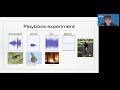
Organisms respond behaviorally to environmentally and biologically relevant stimuli. Species living in areas with frequent wildfires may respond fearfully to acoustic and olfactory wildfire-associated cues. Mo’orea, French Polynesia, is a small tropical island in the South Pacific without large wildfires. We aimed to test whether two closely related, yet distinct, lineages of skinks found on Mo’orea respond to the sound of wildfire. Blue-tailed skinks (Emoia impar) and white-bellied copper-striped skinks (Emoia cyanura) have an evolutionary history of exposure to wildfire, and respond to a variety of acoustic stimuli. We broadcast, to skinks, acoustic cues of a silent control, a predatory bird, a novel nonpredatory bird, and wildfire sounds and quantified their immediate responses to the sounds and their flight initiation distance as a measure of delayed risk assessment. We found that white-bellied copper-striped skinks altered their immediate behavior and delayed risk assessment after hearing the sound of fire. Blue-tailed skinks had fewer changes in their immediate behavior and did not alter their delayed behavior. These behavioral differences may be influenced by niche specialization or geographic stratification during the evolution of the Emoia genus. As wildfires become more common and more severe, even in historically fire-free tropical areas, studying fire responses can provide further insight into ecological resilience during an era of rapid global climate change.
Presentation 4
JAMES LIAO, Dylan Sarver, Aldons Lusis
Age-Dependent Systemic Decoherence: Mapping the Loss of Mitochondrial Rhythmic Coordination across Murine Tissues
Aging is accompanied by widespread metabolic dysregulation, contributing to functional decline and chronic disease risk. This study examines how temporal coordination within and across tissues influences systemic longevity. Using a 48-hour RNA-seq dataset sampled every 4 hours across three life stages—Young (6-month), Aged (18-month), and Old (27-month)—we analyzed rhythmic expression of the MitoCarta 3.0 mitochondrial proteome in six tissues: heart, adrenal, hypothalamus, kidney, muscle, and lung.
Our results show that age-related shifts in metabolic flux, particularly in oxidative phosphorylation, are marked by progressive “Systemic Decoherence.” In youth, mitochondrial genes form synchronized intratissue modules; with aging, these structures dissolve, exhibiting dampened amplitudes and phase shifts. A novel “Synchronization Score” quantified this breakdown, revealing significant decoupling of mitochondrial networks from the circadian clock in aged states.
We further identify key metabolic regulators that act as high-synchrony drivers in youth but collapse functionally with age, while some genes exhibit late-life rhythmic reorganization. These findings support a model in which aging arises from declining metabolic coordination and suggest interventions such as Time-Restricted Feeding may preserve synchrony and extend healthspan.
Presentation 5
MELISSA PÉREZ-RODRÍGUEZ
Glioblastoma is an aggressive brain cancer with limited treatment options, and understanding how kinase inhibitors affect tumor growth remains a critical challenge. Traditional two-dimensional cell culture models fail to capture tumor complexity, motivating the use of three-dimensional neural organoids as a more physiologically relevant system. This project investigates whether deep learning–based analysis of organoid growth dynamics can profile and characterize drug response patterns to kinase inhibitors in glioblastoma.
Neural organoids are cultured and imaged over time to generate time-series data capturing changes in size and morphology. Using IN Carta software, deep learning–based segmentation models identify organoids and extract quantitative features. These features characterize growth dynamics, including proliferation rates and changes under different treatment conditions. Data are analyzed in Python to normalize measurements, compare treated and untreated groups, and identify patterns in compound response.
A computational workflow was developed to process imaging data and extract features of organoid growth dynamics. A machine learning model was developed to profile compound-specific response patterns. Initial analysis reveals distinct growth behaviors across kinase inhibitor treatments, demonstrating scalable, quantitative phenotypic profiling of drug responses and improving identification of effective cancer therapeutics.
Presentation 6
SEBASTIAN SELJAK, Aaryon Meyer, Ethan Hurt, Andrew Ramirez
Traditional bulk sequencing provides an averaged view of gene expression, but single-cell RNA sequencing (scRNAseq) reads data at a per-cell basis. While this offers vastly improved resolution, it introduces significant processing challenges—specifically, high parameter-to-sample ratios that complicate predictive modeling. Evaluating these models via traditional cross-validation often proves imprecise; datasets are frequently either too trivial or too small to outline true predictive differences.
To create a more robust evaluation framework, we propose using probabilistic model outputs to measure "confidence" rather than relying solely on AUROC. By combining confidence-based Brier scores with multi-fold cross-validation, we eliminate data leakage during hyperparameter tuning and penalize highly confident, incorrect predictions more severely than simple "toss-ups."
Our framework includes rigorous stress-testing using synthetic datasets that iteratively increase the signal-to-noise ratio (SNR). This accurately measures performance changes to estimate a model’s utility in real-world, noisy environments. We also incorporate a "junk-cell injection" phase, where phenotypically uncorrelated cells are added to a biologically relevant dataset to "overload" the model while retaining the original signal.
We found that many complex deep-learning models struggle to outperform simpler bulk regression models under this scheme. This framework establishes a rigorous limit of detection for rare-cell-driven pathologies.