Climate, Environment, and Sustainability: Prerecorded presentation - Panel 1
Location: Online - Prerecorded
Presentation 1
ANDREW TSAI, Bharat Venkat
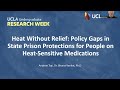
Background: Commonly-prescribed medications including psychotropics, diuretics, and anti-cholinergics can impair thermoregulation, increasing risk of heat-related illness and death. Incarcerated populations face vulnerabilities to heat due to inadequate cooling infrastructure and disproportionately high medication use. This project compares policies for medication-induced heat risk across state correctional settings.
Method: Heat action plans from all 50 state Departments of Corrections were sought through public records requests and publicly-available documents. Of the states from which documents were obtained, 14 contained medication-specific heat action policies. The policies were analyzed in terms of which medications they included, risk stratification, temperature thresholds, operational responses, work restrictions, and inmate education.
Results: Findings reveal inconsistencies across state policies. California and Texas demonstrate tiered protocols, while states like Michigan lack explicit medication-specific provisions. Temperature thresholds triggering intervention also ranged widely, from 85°F in Georgia to a heat index of 105°F in New Jersey. No state addressed the full spectrum of medications identified in the literature as thermoregulatory risks.
Conclusion: These findings highlight the need for standardized heat protections in correctional settings. As rising temperatures intensify heat exposure for incarcerated populations, correctional systems must adapt to protect those most vulnerable to extreme heat.
Presentation 2
JULIA AWAD, CLAIRE SHANK, LOUISE GOLDMAN, GRACE PALUMBO, SYNAIA FAUST, MAYUKHA TALINKI
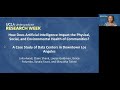
Artificial intelligence (AI) has materialized in cities across the globe, from compromising already finite resources and prompting land rezoning to taking hold of local infrastructures. Whereas AI is packaged as convenient for affluent residents with self-driving cars and automated services, the immensely energy-consuming and polluting data centers powering AI systems are being constructed in historically marginalized neighborhoods. To illustrate, Downtown Los Angeles (DTLA), a predominately low-income neighborhood inhabited by communities of color for business and livelihoods, harbors many of these data centers. Specifically, there are three data centers in DTLA that we are studying: One Wilshire, Digital Realty LAX10, and Equinix LA2.
Through a mixed-methods approach that includes ethnographic note-taking, interviewing residents, and data analysis, this project analyzes (1) the under-researched physical, social, and environmental health impacts of data centers, and (2) the socio-political constructs implicit in data center location, algorithms, and perceptions of technology. We aim to better understand AI on the micro-scale: how ordinary folks in everyday life interact with such mechanisms in increasingly technological urban environments. After having visited the field five times with two additional trips planned, we can tentatively conclude that most interviewees have negative perceptions of AI/the data centers and did not know about the data centers in their neighborhood, signaling a lack of bottom-up consideration.
Presentation 3
MARYAM FAROOQI
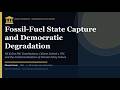
This project examines how fossil fuel political spending shapes environmental policy outcomes in the United States, particularly following the Citizens United decision, which expanded the role of independent expenditures in elections. While climate policy stagnation is often attributed to partisan polarization, this research investigates whether structured financial incentives from the fossil fuel industry systematically influence congressional behavior.
To address this question, I constructed a dataset using Federal Election Commission filings and OpenSecrets classifications to identify fossil fuel aligned contributions to members of Congress across multiple election cycles. I then linked these contributions to legislative behavior by coding votes on major climate-related policies and analyzing patterns across parties and energy-producing states. This approach allows for a comparative analysis of pre- and post-2010 campaign finance structures while controlling for institutional factors such as committee assignments.
Preliminary findings suggest that fossil fuel influence operates asymmetrically across parties but also contributes to divergence within parties, particularly among legislators representing energy-dependent regions. Rather than simply reinforcing partisan divides, campaign finance appears to shape specific patterns of policy alignment and legislative behavior.
Presentation 4
VASILISA KELLOGG, REBECCA FINLEY, DANIELLE BURNSIDE, YURI VASQUEZ, LEAH ACOSTA, AVERY BOURNE, SYDNEY QUAN, Andrew Kleinhesselink
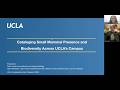
UCLA’s campus presents an array of urban infrastructure and green spaces, creating a mosaic of habitats in which small mammal species persist within an anthropogenic environment. Although biodiversity research at UCLA has increased in recent years, small mammals remain comparatively understudied at the campus scale, despite their importance in ecosystem dynamics. Our research project aims to evaluate and support small mammal biodiversity across various habitat types at UCLA by establishing a baseline inventory of species presence. This understanding will be essential for informing conservation and management strategies that support biodiversity at UCLA.
This assessment utilizes both direct field observations and community-science records. Fieldwork will involve camera traps and bioacoustics to detect small mammals on campus, while interviews and community science resources will supplement and provide insight into our data. Preliminary site assessments, camera deployment trials, and expert interviews have informed our sampling design and data collection protocols.
We are conducting the first of three rounds of field sampling and compiling supplementary data from historical records. To synthesize our findings, we will produce a comprehensive species list and develop web maps to depict spatial differences in species diversity. We will also develop an ArcGIS Story Map to ensure accessibility, alongside a final report that provides recommendations for habitat management to influence campus conservation efforts.
Presentation 5
TIFFANY LIEU, Gregory Pierce, Rachit Dubey
While the increased frequency of extreme weather events has been tied to climate change, media narratives can influence how people understand this relationship. During the January 2025 Los Angeles wildfires, media coverage often overemphasized the role of water mismanagement in the fires’ severity, leading to misunderstanding about the purpose of water management systems. This project aims to measure individuals’ understanding of water management to understand how misinformation and media consumption interact with belief in climate change. This study will survey a representative sample of Californians, the population most directly impacted by the wildfires and most directly exposed to media narratives about the wildfires. We will ask individuals to explain their understanding of various water management topics and their beliefs about contributors to the L.A. wildfires. By comparing participant explanations of water management systems to expert explanations from the Luskin Center for Innovation, we found preliminary evidence that individuals with less accurate understandings of water management systems will demonstrate lower levels of belief in climate change. These findings suggest that media narratives about water mismanagement during the L.A. wildfires may lead individuals to believe that climate change was not a major contributor to the fires. Ultimately, our findings will help explore the role of mass communications in influencing public opinion on climate change.
Presentation 6
DION LYMUEL, SOFIA BARRERAS, ANSUL ADHIKARI, JASMIN DESRUISSEAU, SEIRA HONDA, ZOE IVATT, KEVIN YANG, AMANDA LOI
The Zero Waste Division of the International Urban Sustainability Student Corps (IUSSC) has spent the past two years researching strategies to reduce single-use waste at UCLA, with a focus on high-impact items such as plastic beverage cups. Aligning with UCLA’s broader sustainability initiatives, such as reusable container programs at Ackerman and building off past student-led initiatives such as the 2024 Sustainability Action Research Reusable Container Study, our team conducts applied research to promote the implementation of circular closed-loop systems on campus. Our overall research question examines the feasibility of implementing a reusable serviceware program at public events hosted on UCLA’s campus. Furthermore, our division has committed to a partnership with r.World at the Jazz Reggae Festival (JRF), a student-initiated concert under the Undergraduate Students Association Council’s Cultural Affairs Commission. Through partnering with r.World at JRF, our waste division will mobilize a reusable cup pilot program at various water stations to eliminate single-use waste and highlight the accessibility of sustainable development, as we bridge together environmental consciousness with arts and entertainment. JRF provides a high-volume, highly visible environment to test the effectiveness of replacing single-use beverage containers with reusable alternatives. Our team has also conducted surveys on the perception towards reusables, which we will use to both quantitatively and qualitatively assess this system’s viability.
Presentation 7
ISABELLA DE LA ROSA, LUCIA METCALFE, MONICA MCCALLIN, LUCIE PLANTEVIN, EMMA SACHSE, LIAN WANG, PRESTON LIN
The Anderson School of Management hosts a large number of events involving food and beverages every year. This Sustainability Action Research (SAR) project examines the waste implications of internal and external catering practices at Anderson, in collaboration with stakeholder Alexa Danes, the Executive Director of Building Services at Anderson. We are researching how externally-catered events represent a gap between existing sustainability policies and how they are implemented. Pre-existing literature on event waste management establishes a strong foundation for this research. Our team is using a mixed-methods approach to evaluate waste management at Anderson events, combining observational auditing, waste audits, and qualitative data collection. Thus far, our team has conducted informational interviews with departmental heads at UCLA Sustainability, UCLA Facilities, and ASUCLA Food Services. These interviews provide insight into operational obstacles Anderson faces when dealing with sustainability. We have also conducted an observational audit to gauge what a typical Anderson event looks like. In the next phase of the project, we will expand interview outreach, shift our focus from observational audits to waste audits, and administer surveys across event planners. We will ultimately submit a final report with findings and guidelines for future externally-catered events to Anderson event planners. These deliverables will strengthen Anderson’s sustainability practices across a wide range of event contexts.
Presentation 8
GAURI VISHNOI, Daniel T. Blumstein
Urbanization is a rapid, human induced, environmental change that has led to shifts in the behavioral, physiological, and morphological traits of many species. Notably, birds in urban environments often modify their antipredator behavior when compared to their rural counterparts by exhibiting shorter flight initiation distances (FIDs). While a variety of factors explain this phenomenon, there are still knowledge gaps in how air temperature may affect escape behavior. This is especially important to examine across urban and rural landscapes due to the difference in temperature across these habitats; cities tend to be warmer than neighboring areas due to urban heat island effects. We ask whether and how temperature is associated with avian FID in and around Los Angeles. We fit Bayesian mixed models with temperature as a predictor to examine this relationship and analyzed a subset of species with larger sample sizes using linear mixed models to isolate the effect of temperature on FID. We found a slight positive association between temperature and FID in urban sites suggesting that as temperature increases, birds flee sooner to avoid on-going assessment costs. These results enhance our understanding of how and why wildlife adjust their behavior in the face of a shifting climate.
Presentation 9
ELISE WHITLINGER and Bharat J. Venkat
Incarcerated transgender individuals suffer numerous forms of discrimination, from physical and sexual violence to misgendering and dehumanization. Now their right to necessary medical treatments is in jeopardy too. Since President Trump took office in 2025, the government has attempted twice to ban gender-affirming hormone therapy (GAHT) in federal prisons. This is happening in conjunction with eight states currently engaged in litigation over state laws and/or policies banning GAHT in state prisons. While many advocates’ first concern is the psychological effects such as gender dysphoria that incarcerated transgender people will experience, these bans pose another grave and underexamined threat to their physical health. The sudden cessation of hormone therapy is associated with many side effects including hot flashes, night sweats and other vasomotor symptoms. This is compounded by the fact that incarcerated people are considered one of the populations that is most vulnerable to heat-related illness and death (HRID) due to limited autonomy and restricted access to cooling. This paper argues that sweeping bans of GAHT are putting incarcerated transgender people in the United States at further risk of HRID by intensifying heat sensitivity in a population already predisposed to heat. Ultimately, this paper contextualizes the recent GAHT bans in the broader frameworks of carceral, gender, and environmental justice, arguing that they deliberately contribute to the systemic weaponization of heat against incarcerated populations.