Clinical Medicine, Dentistry, and Public Health: Prerecorded presentation - Panel 1
Location: Online - Prerecorded
Presentation 1
CHRISTINA ABDISHOO, Abigail Hendrie, Gerardo Moreno, Mary Marfisee
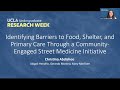
Unhoused populations face disproportionate burdens of chronic disease and food insecurity. In Westwood Village, serious service gaps leave individuals isolated from primary care and nutrition. We implemented a student-led street medicine initiative to provide hot meals, medical care, and social service linkage while assessing community needs. Partnered with local organizations, the UCLA Student-Run Homeless Clinic conducted weekly street medicine rounds for a year. We engaged 77 individuals (nearly the entire local unhoused population) using semi-structured interviews and participant observation. Data was analyzed to identify recurrent needs, chronic conditions, and systemic barriers to care. Participants were mainly middle aged males living in isolation without social support. Key unmet needs included stable shelter, consistent nutrition, and mental health services. Many faced significant hurdles following hospital discharge or incarceration, and none reported a reliable source of free hot meals. Chronic conditions were prevalent but poorly managed due to geographic barriers, competing priorities, and medication storage challenges. Consistent outreach via hot meals was essential for building necessary rapport to navigate complex healthcare and housing systems. This population faces interconnected barriers that perpetuate untreated health conditions. Community-based street medicine serves as a bridge, addressing immediate survival needs while building the trust required to work toward long-term health and housing stability.
Presentation 2
Carole Bartolotto, Nathan Reddy Allipeta
Evaluating Student Engagement Strategies to Promote Food Literacy at University Dining
In 2020, UCLA published a study to identify specific challenges, motivators, and opportunities for university students to develop and apply food literacy. The research revealed that students often feel overwhelmed by conflicting nutritional information. However, they viewed dietitians and the university as reliable sources of information and saw dining halls as an opportunity to learn. UCLA Dining attempted to meet students’ needs by having a dietitian sit at a table with an “Ask the Dietitian” sign, but this intervention did not generate significant student interest.
This study evaluated several additional strategies implemented in front of UCLA Dining eateries including a wheel with nutrition-related questions, a nutrition quiz, and a display showing teaspoons of sugar in sugary drinks. The results suggest that interventions in front of all-you-care-to-eat dining halls, compared to to-go eateries, and the use of a nutrition quiz led to more engagement than the “Ask the Dietitian” sign, the sugary drink display or the spin-the-wheel activity. The nutrition quiz at Bruin Plate had 45 interactions with students in two hours, whereas the ‘Ask the Dietitian” sign in front of a to-go eatery only had only one interaction. Additionally, using a quiz could be customized to address common student misconceptions regarding topics such as beliefs about the healthfulness of coconut oil and protein requirements, which are often influenced by social media.
Presentation 3
ANNIE DING, Haoxuan Chen, and Yifang Zhu
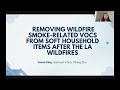
Wildland-Urban Interface fires, including the January 2025 Los Angeles wildfires, pose significant threats to human health and property. Smoke from these fires contains many hazardous chemicals, including volatile organic compounds (VOCs) that can contribute to severe health problems. These chemicals can infiltrate inside indoor environments and be retained in soft household items, including clothing, pillows, towels, and plush toys. Despite the increasing frequency and intensity of these fires, knowledge about effective remediation strategies for these items remains limited. This study evaluates the effectiveness of common cleaning methods, including laundry, dry cleaning, and airing out, in removing VOCs from household items impacted by the Palisades and Eaton fires. Before and after the cleaning process, 30 fire-related VOCs that off-gassed from the items were measured using Selected Ion Flow Tube Mass Spectrometry (SIFT-MS). Initial results indicate that on average, one round of laundry (washing and drying) can reduce the total VOCs in an item by 56%. Additionally, the effectiveness of laundry differs across item types, with clothing items showing a greater reduction in VOCs than pillows. This indicates that certain types of soft items may be more effectively remediated than others as a result of the item’s material, surface area to volume ratio, or other factors. Our results can help inform remediation strategies for household items and support efforts to reduce post-wildfire exposure risks.
Presentation 4
JASMINE GARCIA, Aisha Mohammed, Stephanie Ovalle- Eliseo, Gabriela Islas Huerta, Diana Andrade, Raquel R. Kaufman, Joscelyn Sanchez, Jasmine Cisneros, Lauren Perez, Lorena Monserratt, and Mirella Diaz
U.S. Latine/Hispanic populations are disproportionately affected by Alzheimer’s disease. Yet, there is a significant gap in brain health awareness, especially in communities with limited access to preventative care. To address this, the Equity for Latinx-Hispanic Health Aging (ELHA) Lab developed the Latine–Hispanic Digital Brain Health Program, providing brain health and ADRD prevention education on Facebook to increase accessibility. In this study, we evaluated 50 Hispanic and Latine college students’ reactions to key features of ELHA’s program and assessed how key features impact their likelihood of sharing the content. We developed a mixed-methods design. Participants viewed a set of 5 graphics and 5 videos posted to ELHA’s Facebook page and completed surveys. We conducted descriptive statistical analysis of quantitative data and a sentiment analysis of open-ended qualitative responses. Preliminary findings suggest that participants are willing to share content with family members, citing Spanish-language accessibility and cultural tailoring as key strengths. Several participants reported that Facebook’s interface is less accessible compared to Instagram. As one of the first studies to focus on brain health prevention targeting college students, our study provides insight into how to best utilize social media to boost intergenerational conversations and highlights the significance of culturally tailored brain health prevention efforts among Hispanic and Latine communities.
Presentation 5
MINH-ANH PHAM, ERIN LEE, SARAH ALAMI, ISABELLA ALCANTARA, VALERIE AYZENBERG, DASHMI SINGH, Brisa Garcia, Laurie Shaker-Irwin, and Noah Federman
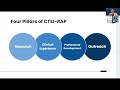
Since its inception in 2013, the UCLA CTSI Research Associates Program (CTSI-RAP) has provided undergraduate students with immersive exposure to academic clinical research and hospital-based medicine. In partnership with 24 Principal Investigators and studies across diverse disciplines, CTSI-RAP supports 58 students, equipping them with the foundations needed to excel as leaders in medicine, research, and public health. Students are integrated into the research process through participant recruitment, data management, and co-authorship of abstracts and papers. Beyond the lab, members have the opportunity to round with critical care teams and shadow clinicians at the Clinical and Translational Research Center. The program also emphasizes professional development and community impact; members are mentored by an extensive alumni network and, in turn, guide high school students in underserved communities. The program’s impact is evident–10-year survey data revealed that 100% of CTSI RAP members cited the program as a meaningful experience in their job, professional degree, or scholarship applications. 90% of alumni remain in the field, highlighting the program's success in training students for future careers in medicine and science. Through weekly didactic sessions, clinical skills workshops, and hands-on experience, CTSI-RAP continues to foster a deep understanding of the clinical research process while preparing students for leadership roles in the evolving healthcare field.
Presentation 6
JIYUN RHIM, Ariana Waters, Yan Wang
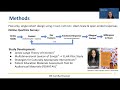
Short-read 16S rRNA sequencing is currently used as a cost-effective tool for oral microbiome analysis, but it is limited in species-level resolution. Long-read (LR) 16S rRNA sequencing is hypothesized to overcome these limitations by capturing the full gene length and is evaluated for its potential to provide precise oral microbial species identification.
Saliva samples were obtained from the MAYA project (2002-2008), a randomized clinical trial of five mother-infant dyads from primarily healthy Hispanic/Latinx women, across prenatal, 4-month, and 9-month time points. Full-length 16S sequencing was performed using the Pacific Biosciences Kinnex 16S rRNA kit, with bioinformatics using QIIME2 and VSEARCH. Sequences were grouped into OTUs at 0.97 similarity, chimeras removed, and taxonomy classified using SILVA-138-99 reference. Alpha and beta diversity were assessed using Shannon/Simpson indices and Bray-Curtis dissimilarity, with an abundance plot to evaluate biological validity.
The abundance plot showed microorganisms consistent with the expected human oral microbiome. Alpha diversity was highest prenatally, lowest at 4 months, and intermediate at 9 months, while beta diversity showed greater dispersion in child samples versus maternal samples, with infants showing lower diversity and Streptococcaceae dominance.
16S rRNA LR sequencing demonstrated accuracy in taxonomic identification and biologically valid diversity, though limitations remain in differentiating certain taxa like Streptococcus mitis and Aeromonas.
Presentation 7
ALEXANDRA STROEMME, VANESSA ALBERSMEIER, Will Pike, Honor Magon, Saurabh Gombar, Masha Stromme, Gavin Hui
Premenstrual Tension Syndrome (PMS) and Premenstrual Dysphoric Disorder (PMDD) are linked to substantial psychiatric comorbidity and healthcare utilization, yet their long-term impact on mental health and treatment outcomes remains poorly characterized. This study examined the development of psychiatric disease and healthcare resource utilization of patients with PMS/PMDD. We conducted retrospective cohort analyses using a nationally representative electronic health record and claims database (>161 million patients, 2015–2024). High-dimensional propensity score analysis was applied to reduce confounding by adjusting for patient comorbidities, procedures, medications, and demographics. Two analyses were conducted, evaluating patients with PMS/PMDD aged 18-40, compared to those who did not have PMS/PMDD, patients with PMS/PMDD treated with SSRI, and those not treated with SSRI. Women with PMS/PMDD had higher rates of anxiety (45.7% vs. 14.2%) and depression (63.8% vs. 10.6%) compared to controls. Among PMS/PMDD patients, SSRI treatment was associated with increased odds of anxiety (OR=2.28), depression (OR=2.32), hospitalization (OR=1.35), and emergency department visits (OR=1.60). These findings show the enduring psychiatric burden of PMS/PMDD despite treatment with SSRIs and suggest that current management strategies, particularly SSRI use, may be associated with greater healthcare utilization. More personalized, cost-effective approaches that integrate hormonal and psychiatric care are needed to improve outcomes for women.
Presentation 8
ARHAN SURAPANENI, Kelsey Ishimoto, Whitney Akabike, Abel Rivas, Leticia Cazares, Maria Vasquez, Jacqueline Fuentes, W. Scott Comulada, Lillian Gelberg, Dallas Swendeman
Accurate identification of substance use is vital for SUD risk screening, prevention, and treatment. Prior research has demonstrated discordance between self-reports and urine drug screens (UDS). This study examines recent agreement patterns between self-reported substance use and UDS in primary care populations, replicating a study conducted in 2011-2015.
Using baseline data from a randomized controlled trial, we compared patient self-reports with blinded self-administered UDS results across drug classes. Self-reported use was collected via mobile-web survey. Clinic stakeholders were interviewed regarding universal UDS versus self-report.
Among 380 baseline UDS samples, cannabis was most frequently detected (44.3%), followed by tobacco (25.1%), methamphetamine (8.0%), stimulants (7.9%), and opioids (4.8%). Cannabis showed highest agreement, with underreporting dropping from 7% in 2011-2015 to 1.3% currently, while substantial underreporting was observed for all other substances. Compared to 2011-2015, underreporting for non-cannabis drugs increased markedly (54% vs. 22%). Stakeholders expressed discomfort with universal UDS, citing concerns about autonomy, consent, and costs.
Lower cannabis underreporting likely reflects increased legalization and normalization. Policy and clinical guidance should prioritize integrated approaches combining patient-centered disclosure with selective, ethically implemented testing, as consent and testing requirements vary considerably by setting and population.