Clinical Medicine, Dentistry, and Public Health: Prerecorded presentation - Panel 5
Location: Online - Prerecorded
Presentation 1
KAYLEE HSIEH
Megan Minamide
Janice B. Schwartz, MD
Derjung M. Tarn, MD, PhD
Background: Clinical trials are essential for evaluating the safety and efficacy of interventions, yet racial and ethnic minority populations, particularly Asians, are underrepresented in U.S. trials. Understanding barriers and facilitators to participation among Asian patients is critical.
Methods: We conducted a systematic review of PubMed, Embase, Web of Science, and CINAHL (1990–April 1, 2025). Two independent reviewers searched for studies on clinical trial participation among Asian populations (Cambodian, Chinese, Filipino, Hmong, Indian, Japanese, Korean, Lao, Thai, Vietnamese). We included original quantitative and qualitative studies of adults over 18 conducted in the U.S.
Results: Of 3,543 articles screened, 6 met inclusion criteria (2 qualitative, 3 survey, 1 mixed-methods). Studies included Chinese, Vietnamese, and Korean participants (50–100% foreign-born) and were conducted in English, Mandarin, Cantonese, and Vietnamese. Common barriers included limited knowledge, mistrust of research, fear of risks/side effects, and language barriers, with subgroup differences in family/community influence. Facilitators included physician or trusted recommendations, perceived community benefit, last-resort care, and incentives.
Conclusions: Few studies examine Asian American subgroups, but findings suggest modifiable barriers (knowledge gaps) and key facilitators (trusted recommendations). Further research is needed to better understand subgroup differences.
Presentation 2
KHUSHI SHARMA, WINTER MOORE, NIKI SHIVA
Addressing Black Maternal Health Disparities Through Community Care: A Baby Box Pilot Program
Black women face significantly higher rates of pregnancy-related death and severe maternal complications than white women due to structural racism, healthcare bias, unequal access to quality care, and persistent social and economic inequities. These disparities increase risks across pregnancy, childbirth, and postpartum, reflecting broader systemic failures in maternal healthcare. This project examines how community-based interventions can address these disparities and asks whether a localized baby box program can improve maternal and infant health outcomes in underserved populations.Drawing on public health literature, maternal mortality data, and existing baby box models, this project proposes an action plan for a pilot program in Los Angeles. Using a community-based public health framework, the plan outlines partnerships with organizations such as the UCLA Mobile Clinic Project (MCP) and the African American Infant and Maternal Mortality (AAIMM) Initiative to distribute essential infant supplies, educational resources, and healthcare connections. By strengthening community support systems and improving access to resources during pregnancy and the postpartum period, this initiative aims to contribute to efforts that reduce maternal and infant health disparities among Black mothers in Los Angeles. The project concludes with implementation steps and scalability considerations for expanding the model to reduce disparities among Black mothers in Los Angeles.
Presentation 3
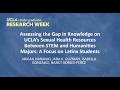
ABIGAIL NARANJO, JADA K. GUZMAN, ISABELLA GONZALEZ, NANCY ROBLES-PEREZ
Objective: Analyze the difference in background knowledge regarding UCLA’s Sexual Health Resources among students who fall under different majors with comparison to each major’s features or demands in order to acquire data on effective methods of marketing.
Methods: A questionnaire survey was presented to 143 UCLA undergraduate students. 62.2% of responses came from students under STEM (Science, Technology, Engineering, and Mathematics) majors while 37.8% of responses came from Humanities majors. 69.9% of responses were accounted for by Latinx individuals. Interviews were also conducted in which more detailed questions were asked on the extent of sexual health resource knowledge and limitations of this knowledge. Sexual health resources on campus, frequency of sexual health topic conversation, and comfortability discussing these topics were all investigated.
Results: Sexual health resource knowledge on campus was lowest for Humanities majors while STEM majors were higher. Both STEM and Humanities major Latinx respondents reported discussing sexual health topics infrequently throughout childhood. STEM majors attributed their knowledge to classes and clubs, while Humanities majors attributed knowledge to tabling on campus.
Conclusion: It is urgent to expand marketing of proper sexual health resource knowledge across locations on campus in a culturally responsive manner. In doing so, prevention of sexually transmitted diseases among students with little background of discussion regarding sexual health topics is possible.
Presentation 4
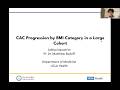
Aditya Narashim, Srikanth Krishnan, Ruben Mora, Beshoy Iskander, Kyvan Irannejad, Natdanai Punnanithinont, Anirudh Chandrasekaran, Suvasini Lakshmanan, April Kinninger, Matthew Budoff
Introduction: Coronary artery calcium (CAC) progression predicts cardiovascular events, more precisely than traditional risk
stratification. While obesity may accelerate atherosclerosis, understanding of the implications of CAC progression across BMI
categories remains limited.
Methods: We retrospectively identified 5,530 subjects who underwent baseline and follow-up CAC scans at least 1 year apart
from April 2016 to April 2025. Annualized change in CAC was compared between subjects with BMI<25, BMI 25-29.9, BMI 30
or more with multiple linear regression with adjustments for cardiovascular risk factors.
Results: Mean age was 60.8+/- 10 years, 62% male, median (IQR) 4 (2, 5) years between scans. There were 1914 (35%) with
normal BMI, 2236 (40%) with overweight BMI, 1,380 (25%) with BMI > 30. The annualized median (IQR) CAC progression in
those with normal BMI was 5 (0, 32), 12 (1, 50) in those with overweight BMI, and 13 (0, 60) in those with BMI > 30. In
multivariable modeling with adjustment for age, sex, diabetes mellitus, hyperlipidemia, hypertension, and past smoking,
annual CAC progression was 13% higher in those who were overweight compared to those with normal BMI (p=0.023) and 22%
higher in those with BMI greater than 30 compared to those with normal BMI levels (p=0.001).
Conclusions: Overweight and obese patients demonstrate 2.4-2.6-fold higher CAC progression than normal BMI. These
findings support BMI-adjusted CAC monitoring protocols and intensified primary prevention in higher BMI populations.
Presentation 5
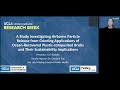
ERIN SCHOLER, Sirri Neba Nforsoh, Vinka Oyanedel-Craver, and Candace Tsai*
*Corresponding faculty author
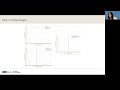
Plastic pollution is a persistent global challenge driven by widespread use of single-use plastics and inefficient waste management, leading to accumulation in landfills and oceans. While plastic-sand composite bricks have emerged as an alternative recycling pathway, limited research has examined materials derived specifically from ocean-recovered plastic, whose unique environmental history may influence the quantity and composition of emitted airborne particles. This study evaluates the number, size distribution, and elemental composition of particles released during simulated construction activities on composite bricks made from ocean plastic, coral, and sand at varying ratios. We investigate whether ocean-derived plastics generate distinct micro- and nanoplastic emissions. Composite bricks were mechanically ground in a controlled environment, and airborne particles were collected using gravimetric sampling tools, including a size-selective respirable and nanoparticle sampler, Tsai Diffusion Sampler (TDS), and a total dust sampler following NIOSH NMAM protocols. Collected particles were characterized via ICP-MS, TEM, and SEM/EDX to identify and quantify composition. Although trials are ongoing, emissions are expected to be comparable to conventional composites, with ocean-derived materials potentially producing smaller or more abundant particles due to degradation, along with mineral or salt signatures. These findings will help determine potential occupational and environmental health risks.
Presentation 6
KIRA THOMASSER, ERIC WANG, EVONNE XU
Degenerative eye diseases including age-related macular degeneration, glaucoma, and diabetic retinopathy impose significant psychological burden on older adults, yet patient-provider communication has not been systematically reviewed across all three conditions. Grounded in Self-Determination Theory, this review used PRISMA-guided methods to synthesize 17 empirical studies examining how intrapersonal and interpersonal communication factors influence psychological and emotional outcomes. Communication failures were pervasive and inequitably distributed, with racial minority patients facing compounding barriers. Where communication quality was higher, patients demonstrated improved self-efficacy, better adherence, and measurably better clinical outcomes. These findings underscore the urgent need for targeted provider communication training within ophthalmologic practice.
Presentation 7
ROMA VASHI, Qi Miao, Steven Raman
Biochemical recurrence (BCR) of prostate cancer is a common clinical issue defined by an increase in prostate specific antigen levels following primary treatment, such as radical prostatectomy or radiation therapy. BCR is associated with an increased risk of metastasis and poorer prognosis. As a heterogeneous disease, the current risk stratification methods of the cancer remain limited, resulting in under treatment or over treatment.
This study aims to develop a predictive model for BCR by integrating radiomic, clinical, pathologic, and molecular subtype data. The cohort includes approximately 260 patients who underwent radical prostatectomy with available RNA sequencing information, preoperative MRI of sufficient quality, and complete clinical and pathological data. Radiomic features are extracted from MRI images (T2-weighted imaging, diffusion-weighted imaging, and ADC maps) from index lesion VOI. These features are combined with clinical variables, pathologic features, and genomic classifications, including molecular subtype. Feature selection and model development are performed using machine learning approaches, including regression and classification based methods to identify patterns associated with BCR.
Through the combination of multimodal data and advanced machine learning techniques, this model seeks to improve risk stratification in prostate cancer patients. Improved prediction of BCR has the potential to guide earlier and more precise treatments, improving patient care and reducing unnecessary interventions.
Presentation 8
Lead Author: AIDEN WONG (AidenWong@g.ucla.edu)
Fiona Donovan (FDonovan@mednet.ucla.edu)
PI: Timothy Fong (TFong@mednet.ucla.edu)
The California Gambling Education and Treatment Services Program (CalGETS) provides no-cost psychotherapy for individuals experiencing problem gambling. This study investigated how demographic factors influence gambling severity at intake and treatment outcomes after 90 days. Unemployed clients reported higher depression, younger clients greater anxiety, and those with lower income or education more frequent gambling urges and poorer mental health. While CalGETS improved overall well-being and reduced gambling severity, subgroup outcomes varied. Unmarried, older, highly educated clients, and lesbian/gay/bisexual participants showed smaller improvements in measures of well-being. Treatment modality was also investigated as a factor mediating outcomes, with results showing treatment delivered exclusively by phone was less effective for reducing co-occurring anxiety.