Clinical Medicine, Dentistry, and Public Health: Prerecorded presentation - Panel 7
Location: Online - Prerecorded
Presentation 1
PALOMA DE'CAMPO, Kyle Mcjunkin, Leona Ofei
Public Health Effects of Food & Textile Waste
Two of the most important and relevant public health issues overlooked today have a deep ripple effect throughout the rest of our society and culture and are a reminder of the nature of our consumerist, capitalist culture which unfortunately feels as if it is ever-growing. I have spent much of my life thinking about these issues as someone who has faced them firsthand and continued to ponder and research the conditions I can personally tackle which set the status quo for consumerism. Food waste (especially as it relates to food insecurity and apartheid) is a public health problem I have been so consumed by my entire life as a child who faced food insecurity. Food waste and textile waste are not isolated issues and they do not exist in a vacuum, they are far-reaching and have global public health effects which are a result of the horrid unsustainable systems that make up the two industries today, and disproportionately affect the global working class.
Presentation 2
FAIZA GIDAY, KHALIL HUSSAIN, Simon Nguyen, Thant Kyi Thu, Nga Man Ng, Jimmy Vuong Nguyen
Artificial intelligence (AI) is becoming more prevalent in our daily lives, bringing changes to the workforce and people at different stages of life. While much research currently shows the advantages that come with the implementation of AI in healthcare, its flaws are not heavily looked at. In this review, we aim to bring attention to the flaws of AI in the healthcare field. We gathered studies that show the limitations of using AI as a replacement for a physician and ways that it can negatively impact physicians’ performance and patient outcomes. We found that while AI can achieve impressive diagnostic abilities and come up with treatment plans, it does not always perform better than that of physicians and when used outside of ideal situations, it can negatively impact physicians’ performance. These studies show that while AI implementation comes with many benefits in healthcare, it is important to keep in mind the limitations of using it in a real life clinical setting. Rather than treating AI as an independent tool, it should be treated as one that assists providers in improving healthcare delivery.
Presentation 3
SANA MEHER, Honghu Liu, Michael Jerrett, Christina Batteate, Wendie Robbins, Jesus A. Araujo
October 23rd, 2015 marked the beginning of the biggest gas blowout in United States history: the Aliso Canyon disaster. Over a period of five months, this calamity released about 109,000 metric tons of pollutants, including methane and ethane, into surrounding communities of the northern San Fernando Valley, located in the City of Los Angeles. Over 130,000 residents living in downstream communities were affected, including a significant portion of seniors and minors. UCLA began a five-year long study, known as the Aliso Canyon Disaster Health Research Study, in 2022 to characterize the disaster’s short term and long term health effects. One phase of the study focuses on conducting clinical assessments on the affected neighborhoods (Porter Ranch, Granada Hills, Chatsworth, and Northridge) and comparison neighborhoods (Simi Valley). During this phase, several clinical assessments, including vital signs, cognitive screening, spirometry, and laboratory tests, are conducted with study participants to gain greater insight into health effects. They are carried out by a research team consisting of UCLA faculty, medical professionals, and trained student volunteers. This presentation briefly explains each assessment and contains a brief literature review explaining the justification for their usage in the study. Data from these assessments are intended to contribute to a greater understanding of the Aliso Canyon disaster and further develop a knowledge base on the effects environmental disasters have on human health.
Presentation 4
KARIME MONTANO
LAMA AHMED
SOPHIA RODRIGUEZ
KATERYN SIMON
SEMELI OLIVAS
LEVI GARCIA
La Lucha for Health
Spanish-speaking immigrant and first-generation families in South Los Angeles face significant barriers when trying to access primary and preventive healthcare, such as language differences, fear tied to immigration status, and mistrust in the healthcare system. However, much of the existing research is quantitatively based and overlooks the lived experiences and strategies families use to navigate these challenges. Through qualitative interviews, this project aims to analyze how Spanish-speaking immigrant families in South Los Angeles navigate structural and cultural barriers to health care, and how these challenges, combined with mistrust of the healthcare system, influence their use of community support networks and alternative approaches to care. The study will conduct semi-structured interviews to explore participants’ lived experiences. While recruitment is ongoing, we hope to have 25 participants from immigrant, first-generation, and mixed-status backgrounds, as well as community health workers and caregivers, from the region. We will analyze the transcripts using thematic analysis to identify common patterns related to barriers, coping strategies, and perceptions of healthcare. Through centering the lived experiences and resilience of Spanish-speaking immigrant families, the project aims to inform culturally responsive, community-based interventions that better reflect and support the realities of underserved populations in South Los Angeles.
Presentation 5
DENNIS NGUYEN, ASHLEY HODGE, MINJUNG CHOI, WARSHA KARASINGHE, ETHAN ZHANG, ANDREA REJI, and Burton Cowgill
The Student Wellness Commission (SWC) is a branch of the Undergraduate Students Association Council at the University of California, Los Angeles (UCLA) that aims to promote holistic student health through effective education, outreach, and event programming. The effectiveness of SWC’s event programming is evaluated through the Event Evaluation Program (EEP) developed by SWC’s Student Education and Research of Contemporary Health (SEARCH) committee. Using survey responses distributed at SWC events, participant and organizer feedback responses and data are collected to conduct analyses. This study examines trends in event effectiveness by analyzing attendance patterns, student reach, and perceived health knowledge gained from SWC events over the academic years from 2021-2022, 2022-2023, and 2023-2024. Expected vs actual attendance varied in 2021-2022 and 2022-2023, but in 2023-2024, attendance generally exceeded expectations. Results show that in all three academic years, over half of the students who attended these events believed that they gained knowledge and/or skills that will benefit their overall health and well-being. These findings have implications for event marketing strategies and can inform the types of events that are organized in the future to increase student reach.
Presentation 6
MAX NGUYEN, IVY KWOK
Despite their nuanced positionality, Vietnamese Americans remain underrepresented in gerontology research. A complex culmination of pre-migration traumas, acculturation processes, and social determinants of health shape Vietnamese-American aging dynamics.
Notably, post-migration acculturation was suggested to be associated with physical functioning, chronic disease risk, and health behaviors that ultimately impact aging trajectories in tandem to broader environmental and socioeconomic influences. Ethnic enclave living, strong family cohesion, and social support networks acted as possible protective buffers against loneliness and depression associated with disability and physical decline. Pre-migration exposures to war traumas and early childhood adversities like refugee camps and the “boat person” experience also played a multi-faceted role in the lasting physical and mental health of Vietnamese elders in the United States. Alongside socioeconomic barriers, other social determinants of health, like healthcare access and education, also contributed to the complex aging progressions of diasporic Vietnamese seniors.
Overall, this presentation synthesizes existing literature to link the structural context of the Vietnamese immigrant experience to trends seen throughout the aging process—highlighting the current limitations of applying the immigrant health paradox to a heterogenous population shaped by distinct needs and challenges.
Presentation 7
JOSCELYN SANCHEZ, Aisha Mohammed, Stephanie Ovalle-Eliseo, Gabriela Islas Huerta, Diana Andrade, Raquel Kaufman, Jasmine Garcia, Jasmine Cisneros, Lauren Perez, Lorena Monserratt, Mirella Díaz-Santos
The US Latine/Hispanic population faces the largest projected increase in Alzheimer’s disease and related dementia (ADRD) cases from 2015 to 2060, with 1.5 times greater risk than their non-Hispanic White counterparts. Although many ADRD risk factors can be modified in young adulthood, people aged 18 to 39 have limited knowledge of ADRDs and remain underrepresented in prevention research. This study evaluates a culturally responsive educational blog about brain health tailored to Latine/Hispanic college students, examining whether a culturally adapted blog improves ADRD knowledge, acceptability, and willingness to share information with family versus a non-culturally adapted blog. A randomized posttest-only control group design was employed, in which UCLA undergraduate students self-identifying as Latine/Hispanic were assigned to our culturally adapted ELHA blog (n=8) or the Alzheimer’s Association (not adapted) blog (n=15). ADRD knowledge, blog acceptability, and willingness to share with family were measured. Both groups demonstrated moderate-to-high ADRD knowledge with no significant between-group differences. Acceptability and willingness to share were comparable, with slightly higher mean acceptability for the ELHA blog. These findings offer preliminary insight into how blog-based education may support brain health awareness and intergenerational knowledge sharing in Latine/Hispanic families, informing culturally responsive ADRD research among young adults.
Presentation 8
SEAN KIM, Andrew Tsai, JESSICA NGUYEN, IRENE OH, FIONA ZHANG, EVELYN LIU, Do Yeun Park, Kyle Lee,
Burton Cowgill
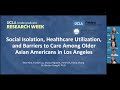
Social isolation among elderly Asian Americans is a public health concern with crucial implications for healthcare utilization and health. Research suggests that socially isolated individuals are more likely to rely on acute care while underutilizing primary and preventive care, but limited studies have explored the Asian American population. This study examines the relationship between social isolation and healthcare utilization in elderly Asian Americans in Los Angeles using a mixed-methods approach. Structured questionnaires at health fairs collected data on demographics, chronic conditions, healthcare utilization, and social isolation levels using the Lubben Social Network Scale. Descriptive statistics were used to find associations between social isolation and healthcare utilization while controlling for demographic covariates. Thematic analysis of qualitative interviews explored healthcare experiences, support networks, and barriers to care. Early findings show socially isolated individuals are more likely to use acute services and less likely to seek primary and preventive care. Barriers included unfamiliarity with the healthcare system, cultural stigma, and language access. These findings suggest the need for culturally tailored interventions such as community-based social activities and health fairs. Future research should investigate longitudinal trends and efficacy of programs for mitigating social isolation’s effects on aging Asian American populations.