Neuroscience: Prerecorded presentation - Panel 1
Location: Online - Prerecorded
Presentation 1
JASHAN MAHAJAN, KATIE CHAN, ABHIRAMI NAIR, KIRA SIDHU, LORELEI GARRISON, INA MALKOUARI, ALICE TANG, EMILY LUO, ARIANNE HOSSEINI, ANSHU DESAI, MAHDOX GANTONG, MICHELLE LUO, NATASHA CHINNAGIRI
Stroke is a leading cause of long-term disability worldwide, yet the biological mechanisms for vast differences in recovery outcomes are poorly understood. There is growing evidence that the immune response to a stroke is significant to the recovery process that differs meaningfully by sex, and that comorbidities, such as hypertension, further modulates recovery. Despite this, existing studies examine these variables in isolation and analyze outcomes from single datasets. This project takes a different approach by utilizing four GEO transcriptomic datasets into a machine learning model to identify sex-specific immune signatures that may explain differences in stroke recovery. The study incorporates a meta-analysis of immune gene expression across four independent GEO datasets to identify consistently dysregulated genes and assess differences by sex and comorbidities. Following this, a machine learning model using random forest classification to predict stroke status and recovery from immune gene expression, with preliminary models achieving 0.91 AUC. Models are trained on one dataset and validated on others to test whether findings generalize across patient populations, and ultimately GADD45G (among other genes) emerged as a female-specific predictor. Further, the IST clinical dataset provides data that bridges the biological finding to real-world recovery differences. This work advances understanding of stroke biology and highlights the potential of machine learning to inform personalized, sex-specific recovery predictions.
Presentation 3
HEATHER LIU, Kirsten Takeshima, Elle M. Rathbun, and S. Thomas Carmichael
Stroke is a leading cause of disability. Ischemic stroke causes irreversible brain damage and limited endogenous repair, but biomaterial strategies like microporous annealed particle (MAP) hydrogels have emerged to support tissue repair. Their regenerative potential can be enhanced through delivery of vascular endothelial growth factor (VEGF) via clustered VEGF nanoparticles (CLUVENA). While prior work suggests MAP hydrogels with CLUVENA (MAPcV) do not alter the intensity of astrocytic markers in the infarct core, its effects in the peri-infarct remain unclear. We investigate how MAP and MAPcV hydrogels influence astrocyte and oligodendrocyte progenitor cell (OPC) responses following photothrombotic stroke in young adult male mice. Using confocal imaging and Imaris analysis, we quantify astrocyte and OPC marker expression in defined peri-infarct regions (distance from infarct border: 0-100 µm, 100-300 µm) at 30 and 60 days post-stroke. In these regions, MAPcV hydrogels exhibit lower astrocyte marker intensity than MAP hydrogels at day 30, while maintaining consistent expression levels through day 60 unlike MAP hydrogels. Due to the oligodendrocyte lineage of astrocytes, we also look at OPC intensity in the same regions. Similar to astrocyte markers, it was decreased in MAP hydrogels, but sustained in MAPcV hydrogels at chronic timepoints. These findings suggest that VEGF delivery may interact with astrocyte and OPC populations to maintain and support a reparative environment into chronic timepoints within the peri-infarct.
Presentation 4
Titilope Olotu, Taylor Davis, Micah Ralston, Asha Fletcher, Ketema Paul.
Polycystic Ovary Syndrome (PCOS) is the most common endocrine disorder among women of reproductive age, affecting roughly 8 to 13 percent of this population worldwide. Although it is primarily defined by hyperandrogenism, ovulatory dysfunction, and polycystic ovarian morphology, PCOS also has wide-ranging effects on sleep quality and sleep homeostasis that are not yet fully understood. This research examines the specific neuroendocrine mechanisms through which hormonal dysregulation in PCOS disrupts sleep-wake cycles, homeostatic sleep pressure, and circadian rhythmicity. The sources used in this research come from clinical endocrinology, sleep science, and neuroendocrinology, with particular attention to how androgens, insulin resistance, and reproductive hormonal changes affect the neural circuits that regulate sleep. A qualitative systematic literature review was used to synthesize findings from peer-reviewed studies and laboratory-based work from the Paul Lab at UCLA. The findings indicate that sleep disturbances in PCOS are tied to the hormonal environment of the condition rather than obesity alone, that these disturbances continue throughout the lifespan, including into postmenopause, and that sleep quality is a meaningful and modifiable factor in managing PCOS. This research matters because it connects neuroendocrine theory with clinical sleep data to support more targeted, hormone-aware treatment approaches for a population that is often overlooked in sleep medicine.
Presentation 5
CLAIRE PETER, Juliana Corlier, and Andrew Leuchter
Repetitive transcranial magnetic stimulation (rTMS) is a neuromodulatory technique used for the treatment of major depressive disorder (MDD). However, individual differences in treatment response remain poorly understood. This study investigates whether demographic and clinical factors such as gender, or the presence of chronic pain and anxiety are associated with differences in clinical outcomes to rTMS treatment.
I hypothesized that gender and depression severity at baseline would be associated with measurable differences in depression treatment responses, which would interact with pain and anxiety variables.
A retrospective analysis was conducted using data collected from 875 participants who received rTMS treatment for MDD at the UCLA TMS Clinical and Research Service. I performed statistical analysis in R using regression-based models to examine the associations between gender, pain severity, anxiety levels, and treatment outcomes.
My analyses revealed that severe chronic pain was associated with worse MDD response, whereas anxiety was not significantly correlated with depression improvement. Furthermore, gender showed no interaction with anxiety or chronic pain levels, though male patients trended towards greater improvement.
In the next step, I will capitalize on these findings to examine differences in neural activity patterns via electroencephalogram (EEG) analysis. These findings show the importance of examining interactions between clinical and demographic factors in informing more personalized approaches to care.
Presentation 6
SOPHIA SILVERMAN, Yuan Xin Gogh, Angelo Grajeda, Anisa Subbiah, Chunni, Zhu, Jesus Campagna, and Varghese John
Enteric Nervous System Proteostasis as an Early and Predictive Model of Neurodegenerative Disease
Neurodegenerative diseases such as Alzheimer’s and Parkinson’s are characterized by disrupted proteostasis, including accumulation of α-synuclein and phosphorylated tau. While these processes are classically studied in the central nervous system (CNS), emerging evidence suggests pathology may also arise in the enteric nervous system (ENS). This study investigates whether proteostatic dysfunction in the ENS parallels or precedes CNS pathology across transgenic mouse models (ASO, E4FAD, HuMAPT, 3xTg). Enteric neurons were isolated, cultured, and analyzed using AlphaLISA, ELISA, and BCA normalization to quantify α-synuclein, tau, and related biomarkers under time-course and pharmacological conditions. ENS cultures were reproducibly established and exhibited stable neuronal–glial populations with measurable, genotype-dependent protein signatures. Although biomarker levels were lower than in CNS tissues, assay optimization—including correction for high-dose hook effects—enabled reliable cross-tissue comparisons. These findings demonstrate that the ENS is a quantitative and experimentally tractable platform for proteostasis analysis. This work establishes a framework for determining whether peripheral pathology reflects early or parallel neurodegenerative processes and supports the ENS as a potential system for early biomarker discovery and therapeutic development along the gut–brain axis.
Presentation 7
NOAH ST CLAIR, Alapakkam Sampath, Gordan Fain, Rikard Frederiksen, Paul Bonezzi, Christopher Meredith, Annabelle Tran, Isabelle Rieke-Wey
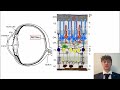
Rod photoreceptors maintain a depolarized membrane potential in darkness and is known as the dark current. This is a process that imposes a substantial metabolic burden. To meet this demand, photoreceptors rely on aerobic glycolysis, or the Warburg effect, a metabolic strategy also observed in cancer cells. While inhibitors of this pathway are being developed for therapeutic use, their effects on neuronal physiology remain poorly understood.
My work investigates the impact of glycolytic inhibition on rod photoreceptor function using NG52, a phosphoglycerate kinase 1 inhibitor. Retinal responses are measured using ex vivo transretinal electroretinography in a mammalian model. Rod-specific activity is isolated using genetic and pharmacological approaches, including GNAT2 knockout conditions and application of DL-AP4 and BaCl2.
Preliminary observations suggest that inhibition of glycolysis preserves overall rod sensitivity while altering response kinetics, reflected by an increased time to peak of the a-wave at low light intensities. This indicates that metabolic disruption may differentially affect the magnitude and timing of photoreceptor responses.
These findings provide insight into the relationship between energy metabolism and sensory function, with implications for both retinal physiology and the off-target effects of metabolic therapies.
Presentation 8
KIMBERLY WEI, Anne Freelin, and Genevieve Konopka
The temporal cortex, composed of six distinct layers, plays a central role in higher-order memory processing, exhibiting strong connectivity and oscillatory activity associated with memory. Central to these processes is cholinergic signaling via acetylcholine, a key modulator of cortical network dynamics. Acetylcholine is essential for cognition, and its degradation is a hallmark of many dementia-related neurological diseases.
Local field potentials (LFPs) measure neural oscillations critical for higher-order cognition by facilitating synchronous activity across brain regions and reflecting coordinated neural ensemble dynamics. In this study, using human organotypic slice culture, we specifically examined theta-band oscillations, with slow theta (2–5 Hz) known to be sensitive to cholinergic tone and implicated in memory encoding. Cortical networks exhibit distinct oscillatory dynamics linked to specific cognitive functions, and different cortical layers have specialized roles.
We investigated laminar-specific electrophysiological changes in organotypic human cortical slices through cholinergic modulation via carbachol, modeling in vivo-like network states. By mimicking active memory states ex vivo, we assessed whether deep output layers (V/VI) and superficial input layers (I–III) exhibited distinct theta oscillatory responses to increased cholinergic tone. These findings provide insight into layer-specific contributions to cognition and may inform biomarker development and targeted therapies for memory disorders.
Presentation 9
CHARLIZE YIP, Sydney Kilgore, Katy Figuerora, Keith Vossel
Subjective cognitive decline (SCD), or self-perceived memory decline, is often used in neurological care as an indicator of future cognitive impairment. Few studies in diverse cohorts have compared SCD with objective cognitive performance (OCP) while considering social determinants. We examined whether loneliness, discrimination, and genetic risk were associated with SCD and whether SCD reflected OCP.
Participants from the Dementia Research, Education, and Advancement in Los Angeles (DREAM-LA) study completed the Geriatric Depression Scale, 10 Likert scale questions, and the Mini-Mental State Exam (MMSE) to assess their SCD, loneliness, discrimination, and OCP. APOE-genotype was from whole blood samples. Analyses compared SCD groups across Asian American and Pacific Islander, Black/African American, and Hispanic/Latino participants.
Among participants with SCD data (SCD+: n=32; SCD−: n=52), MMSE scores did not differ between the groups (MeanSCD+=27.50+/-2.69; MeanSCD-=27.58+/-2.46). In contrast, SCD+ individuals reported significantly higher loneliness (MeanSCD+=12.90+/-4.60; MeanSCD-=3.05+/-3.78, p<0.001). SCD+ Hispanic/Latino participants reported greater loneliness than SCD- (p=0.02). Discrimination scores were not associated with SCD. APOE-ɛ4 carriers showed no differences across measures.
In this study, SCD was linked to loneliness, but not OCP, suggesting psychosocial influences.
SCD alone may not indicate early impairment and should be interpreted in broader social contexts, especially in underrepresented groups.