Neuroscience: Prerecorded presentation - Panel 3
Location: Online - Prerecorded
Presentation 1
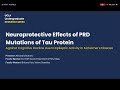
ALEXANDRA BUTNARIU, Vishnu Shandilya, Brittany Katz, Keith Vossel
There are currently over 55 million people in the world diagnosed with Alzheimer’s Disease (AD). Amyloid beta plaques and tau hyperphosphorylation are two widely acknowledged causes of AD but their mechanisms remain unknown, resulting in no known cure despite the large affected population. A central challenge in the field is identifying how specific protein interactions drive early synaptic dysfunction. This study addresses this gap by examining how altering tau’s PRD domain influences and might be protective against hyperexcitability. The results support the hypothesis that tau-PRD knock-in mutations provide protection against synaptic hyperexcitability and seizure activity. The significant increase in seizure latency and reduced EEG spike frequency of the AxxA6 knock-in model suggests that altering this specific binding site might mitigate some of the effects of tau hyperphosphorylation. The R221A knock-in mutation saw similar results at the synaptic, local level of the CA3, but no significant results in the in vivo models. The ultimate goal of this research is to determine if tau protein binding to SH3-containing proteins such as Fyn represents a viable target for small-molecule drug therapies that could block this interaction and prevent early cognitive decline.
Presentation 2
MADISON DAWSON, Kathleen O'Hora
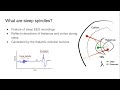
Background: 22q11.2 deletion syndrome (22q11.2DS) is a common genetic disorder often accompanied by Autism Spectrum Disorder, Attention Deficit Hyperactivity Disorder (ADHD), and psychotic disorders. These disorders involve disruptions in neural circuits regulating sleep and sensory processing. Sleep disturbances are common in 22q11.2DS, suggesting sleep physiology may provide insight into neural abnormalities. Sleep spindles, a feature of EEG, reflect thalamocortical interactions generated in the thalamic reticular nucleus. These pathways filter sensory input, and abnormalities may contribute to sensory difficulties. Increased spindle density suggests altered thalamocortical connectivity is linked to sensory processing challenges. This study examines the relationship between sensory processing difficulties and sleep neurophysiology. We hypothesize increased spindle density is associated with greater sensory difficulties.
Methods: Sleep EEG data were collected using a portable headband (Dreem 3) for home monitoring (1–8 nights; median=3). Data were preprocessed using LUNA. The sample included 20 22qDel carriers and 19 typically developing controls. Spindles (10–16 Hz) were detected during NREM sleep. Group differences were analyzed using linear mixed effects models.
Results: 22qDel carriers showed an altered spindle frequency distribution, with differences at 12.5 Hz (b = -0.55, p = 0.02).
Conclusions: 22qDel carriers show differences in spindle frequency distribution, potentially reflecting altered thalamocortical circuitry
Presentation 3
Misale Mesfin, NHI DOAN, Natalie Shink, Nigel Arreola, Ryan Ma, Olujimi Ajijola
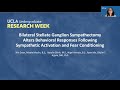
The stellate ganglion (SG) provides primary sympathetic innervation to the heart and plays a key role in autonomic regulation. While sympathetic activation is linked to anxiety-related responses, the contribution of SG signaling to anxiety-like behavior remains unclear. This study investigated whether bilateral SG sympathectomy (BSG) alters anxiety-like behavior following pharmacologic sympathetic activation and fear conditioning. Female C57BL/6 mice were randomized to receive BSG or sham surgery. After recovery, mice were administered isoproterenol to induce sympathetic activation and assessed for freezing and anxiety-related behavior. Baseline anxiety-like behavior was evaluated using the open-field test (OFT) and novelty suppressed feeding (NSF) assay. Mice then underwent fear conditioning with inescapable foot shock paired with an auditory tone, followed by repeat behavioral testing in the presence of the conditioned stimulus.
Sympathetic activation induced behavioral inhibition characterized by freezing-like responses. Following fear conditioning, BSG and sham mice exhibited divergent anxiety-like behaviors in the OFT, with BSG mice showing altered responses to conditioned threat cues. These findings suggest that SG signaling contributes to anxiety-related behavior, particularly under conditions of sympathetic activation and learned threat. Ongoing histological studies aim to further characterize associated neural activation patterns.
Presentation 4
AVA HASHEMI, DARON MANOUKIAN, Sotiris Masmanidis
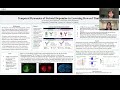
Animals rely on well timed movements to interact effectively with their environment, such as anticipating rewards or capturing prey. These abilities are learned through experience, suggesting that neural circuits encode both reward and reward timing. The striatum, a central structure of the basal ganglia, receives dense dopaminergic projections from the midbrain that shape learning through reward prediction errors. However, how dopamine contributes to learning the timing of expected rewards remains unclear. This project tests the hypothesis that dopaminergic signaling in the striatum reinforces both rewarding outcomes and their timing, and that temporally precise dopamine activity in the ventral striatum is required for learning expected reward timing. C57BL/6J mice are trained on a classical conditioning task in which a cue predicts delivery of sweetened milk after a fixed interval. Animals express a virally delivered dopamine sensor (dLight) and are implanted with an optical fiber targeting the ventral striatum for fiber photometry recordings. Fixed brains are sectioned and undergo immunohistochemical staining with primary and secondary antibodies to label tyrosine hydroxylase and dLight expression. Fluorescence microscopy verifies optical fiber placement and viral expression in the ventral striatum. These confirmations ensure photometry signals reflect dopamine activity, supporting interpretation of dopamine timing during reward learning.
Presentation 5
HUETE, M., COOPER, G.T., Perez, M., Pontanares, J., Ghahremani, D.G.
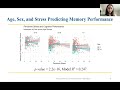
Previous research suggests that experiencing adverse life events tends to have a negative impact on memory performance, potentially due to associated stress. We investigated this relationship in older adults, hypothesizing that individuals who reported experiencing a higher number of adverse life events and higher perceived stress are more likely to demonstrate lower memory performance.
Data was obtained from the Aging Adult Brain Connectome (AABC), a multi-site longitudinal study of aging including 1066 participants, ranging in age from 36 to 90+ years old. Adverse life events were assessed using the Geriatric Adverse Life Events Scale (GALES), a 26 item self-report measure designed to assess the experience of specific life events and their perceived emotional impact. Memory performance was measured using a composite score from a factor analysis of data from a cognitive battery, including MoCA, RAVL-T, and tests from the NIH Toolbox.
Pearson correlation analyses were conducted to examine the relationships, and results indicated that there was no significant association between total adverse life events and memory performance. Similarly, perceived stress of the events was not significantly correlated with memory cognition. These results suggest that neither the total number of adverse life events nor the perceived stress levels were significantly associated with memory in this sample. Instead, demographic factors, including sex and age, have a larger role in explaining differences in memory performance.
Presentation 6
MAHEK PATEL, Mahlet Mekonnen, Anubhav Chandla, Brian Aguirre, Isaac Yang, Madhuri Wadehra
Glioblastoma (GBM) is a heterogenous, fast-growing, and aggressive tumor that represents a vast majority of adult malignant brain cancers. Standard care includes surgery, radiotherapy, and Temozolomide. These therapies rarely lead to full cures, instead they help prolong survival by around one year. The ineffectiveness of these therapies have been linked to Glioblastoma stem cells (GSCs), a subpopulation of cells in GBM, that lead to tumor heterogeneity, therapy resistance, and recurrence.This study analyzed three GBM cell lines HK336, HK374, and GS154 under two different conditions, adherent (AD) and non-adherent (NA), for transcriptomic differences and pathways related to GSCs. RNA sequencing was performed in triplicates for each of the cell lines under both conditions. Differentially expressed genes were identified between conditions for all three cell lines and downstream functional analysis, including but not limited to Gene Ontological Enrichment and Gene Set Enrichment Analysis, was conducted to find significant impacted pathways. The NA condition was found to have enriched pathways related to Hypoxia, Stem Cell Differentiation, and Angiogenesis in comparison to the AD condition across cell lines. Three genes were found to be upregulated in the NA condition across all three cell lines: CEBPD, GFBP3, and ANGPTL4. These genes could be key factors in GSC-associated therapeutic resistance.
Presentation 8
DAVID PORTUGAL, SAMUEL TSU
Our group will be presenting about possible differences in estimated blood loss that arise due to the use of cranial plates and screws within intraoperative spinal surgery. We did so by taking data from INI surgery logs and sorting results by whether cranial plates and screws were used, and compared that group to a randomly selected control. Through a box model with bootstrapping, a p-value of 0.2617 was obtained. As a result, we fail to reject the null hypothesis. Possible improvements to the study include further regulation of controlled variables, such as surgeon, spinal level, and hospital performed at.
Presentation 9
ARMITA SHADFAR, Jesus Campagna, and John Varghese
Alzheimer’s disease (AD) is a neurodegenerative disorder characterized by impaired cell survival signaling, including reduced activity of the AKT pathway. AKT phosphorylation (pAKT) plays a critical role in promoting neuronal survival, differentiation, and resistance to stress, making it a valuable target for studying potential next generation therapeutic strategies in AD. Cytokines such as IL-6 and peptides like Humanin are known to activate this pathway and serve as useful positive controls in experimental models. Small molecules developed in the lab, including compounds such as DDL-838, are being tested for their ability to bind to the Humanin receptor gp130 and mimic these neuroprotective effects. To evaluate pAKT signaling, AlphaLISA, an immunoassay-based technique, was used to quantify protein levels in cell samples. This method relies on antibody binding and proximity-based signal generation to detect specific proteins with high sensitivity. Experiments were conducted using U-87 cells treated with controls and experimental compounds, with varying incubation times to determine optimal conditions for measuring pAKT prior to cell lysis. By analyzing pAKT signaling under these conditions, this study aims to establish a reliable assay framework for assessing compounds that may promote cell survival pathways relevant to AD. Overall, the findings suggest that pAKT activation is most effectively captured at later time points and that experimental compounds such as DDL-838 may promote measurable pro-survival signaling.